
Articles
Converting Rooftop Units into Green, Energy-Efficient Systems

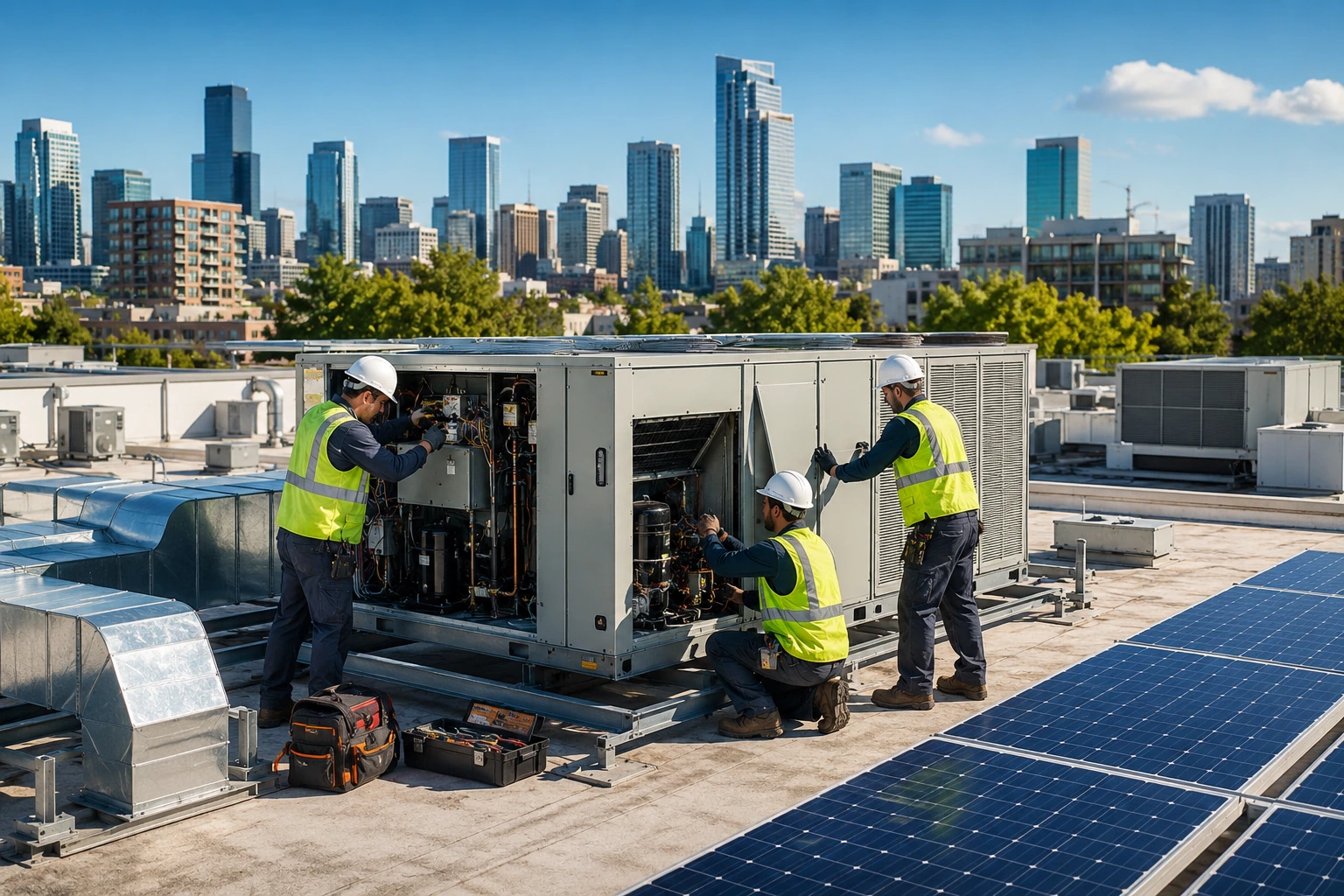
Converting Rooftop Units into Green systems is no longer a cosmetic sustainability move; it is one of the most practical ways commercial building owners can cut operating costs, improve comfort, and reduce carbon emissions without redesigning an entire property. A rooftop unit that once ran on fixed schedules, aging compressors, and reactive maintenance can become a smarter, cleaner asset through controls, electrification, airflow correction, and performance tracking.
| Key Area | What It Means for Building Owners |
|---|---|
| Main opportunity | Replace or retrofit old RTUs with efficient, low-carbon equipment |
| Best first step | Audit unit age, runtime, airflow, controls, refrigerant, and utility data |
| High-impact upgrade | Advanced controls, economizers, variable-speed fans, and heat pump RTUs |
| Carbon strategy | Reduce waste first, then electrify heating where technically feasible |
| Performance risk | Poor airflow, oversized units, and neglected maintenance can erase savings |
| Ideal outcome | Lower utility bills, better comfort, fewer complaints, and measurable emissions reduction |
Why old rooftop units waste so much energy
Commercial rooftop HVAC systems often stay in service long after their best performance years have passed. The unit may still cool the space, but that does not mean it is operating efficiently. Common problems include constant-speed fans, failed economizers, dirty coils, leaking dampers, short cycling, inaccurate sensors, and controls that do not match occupancy.
The U.S. Better Buildings Solution Center has made the savings case clear. As the program notes:
“Upgrade your RTUs and reduce energy use by 30 to 50%.”
That range depends on climate, building type, utility rates, operating hours, and the condition of the existing unit, but it explains why RTU projects deserve attention in capital planning.
For owners managing retail centers, warehouses, offices, schools, clinics, and light commercial buildings, rooftop unit retrofit work can be easier to phase than deep interior mechanical renovation. The roof already holds the equipment, curb locations are established, and tenants can often remain in place while upgrades are scheduled.

The green conversion starts with measured performance
A strong sustainability project does not begin with a product catalog. It begins with evidence. The first step is documenting how the existing RTUs actually behave during occupied and unoccupied hours.
A practical assessment should review:
- Equipment age, capacity, refrigerant type, and maintenance history
- Compressor staging, fan operation, economizer function, and heating source
- Zone temperature complaints and hot/cold patterns
- Energy bills, demand peaks, and runtime trends
- Outside-air settings and ventilation performance
- Roof access, curb condition, electrical capacity, and drainage
This is where FilabiCo’s Project Workflow can be framed as a disciplined path: inspect, measure, model, prioritize, install, commission, and verify. That sequence prevents the most expensive mistake in HVAC sustainability—replacing old inefficiency with new inefficiency.
Retrofit or replace: choosing the right route
Not every RTU needs immediate replacement. Some units can deliver strong commercial HVAC energy savings through targeted retrofit packages. Others are too old, oversized, unreliable, or carbon-intensive to justify more investment.
| Condition of Existing RTU | Best Strategy | Why It Works |
|---|---|---|
| 5–10 years old, structurally sound | Controls retrofit | Captures savings without full replacement |
| Failed economizer, poor scheduling | Economizer repair + smart controls | Reduces unnecessary mechanical cooling |
| Constant-speed fan | Variable-speed fan upgrade | Cuts fan energy and improves part-load operation |
| Aging gas heat RTU | Rooftop heat pump replacement | Supports commercial building decarbonization |
| Frequent compressor failures | High-efficiency RTU replacement | Reduces downtime and waste |
| Poor zone comfort | Air balancing + controls tuning | Corrects delivery before adding capacity |
The U.S. Better Buildings Commercial Building HVAC Accelerator is focused on next-generation RTUs from 2024 through 2027, with the goal of accelerating efficient, cost-effective solutions that can reduce energy costs compared with conventional packaged rooftop units.
Green HVAC Design is not only about the unit
A rooftop unit is part of a larger building ecosystem. Green HVAC Design looks beyond nameplate efficiency and considers how the system behaves in real operating conditions. A high-efficiency unit connected to poor ductwork, incorrect outside-air settings, or weak controls will underperform.
Good design answers four questions:
- Is the RTU sized for the current load, not the original guess from years ago?
- Can the unit reduce speed and capacity during part-load conditions?
- Does the control system match real occupancy patterns?
- Can performance be verified after installation?
ASHRAE’s decarbonization resources emphasize planning around the building itself, stating that “decarbonization planning should focus on the core operations of a building.” For RTUs, that means reducing wasted energy before or alongside electrification.
The role of Smart HVAC IoT in modern RTU upgrades
Smart HVAC IoT turns rooftop units from isolated machines into monitored assets. Sensors, controllers, gateways, and analytics can track runtime, supply-air temperature, outdoor-air conditions, faults, and energy patterns. This is especially useful across multi-site portfolios where manual inspections are inconsistent.
Advanced rooftop unit controls can include:
- Occupancy-based scheduling
- Demand-controlled ventilation
- Economizer fault detection
- Supply fan speed control
- Remote alarms for abnormal runtime
- Automated fault detection and diagnostics
- Tenant comfort trend analysis
Recent Better Buildings material on advanced RTU controls notes that thermostat control retrofits can save up to 50% of energy consumption by better matching system operation to building needs. The real value is not only energy reduction; it is visibility. Owners can see which units are wasting money before the monthly utility bill arrives.
Sustainable HVAC upgrades that cut carbon
Low-carbon HVAC solutions usually work best in layers. Start with the lowest-cost waste reduction measures, then move toward larger capital improvements.
A smart sequence often looks like this:
- Repair economizers and dampers
- Add advanced rooftop unit controls
- Correct scheduling and setpoints
- Clean coils and replace clogged filters
- Balance airflow and verify ventilation
- Upgrade to variable-speed fans
- Replace failing RTUs with high-efficiency HVAC systems
- Electrify heating with rooftop heat pump replacement where the building and grid support it
Heat pump packaged RTUs are especially important for commercial building decarbonization because they can reduce or eliminate onsite combustion for space heating. ASHRAE notes that heat pump guidance for commercial and multifamily buildings includes climate zones, system configuration, refrigerants, electrical requirements, and control strategies.

Why Air Balancing Matters after an RTU project
Why Air Balancing Matters is simple: even the best rooftop unit cannot perform well if conditioned air does not reach the right zones at the right volume. Poor airflow causes comfort complaints, excess fan energy, short cycling, humidity problems, and unnecessary service calls.
Air balancing should not be treated as a closeout formality. It is the bridge between design intent and real occupant experience. During a rooftop unit retrofit, technicians should verify supply airflow, return airflow, outside air, damper positions, static pressure, and zone delivery. When the data is wrong, the system may need duct repairs, damper adjustment, fan tuning, or control changes.
For building owners, air balancing protects the investment. It helps ensure that efficiency gains are felt in the space, not just promised in the proposal.
Where energy-efficient chillers fit into the discussion
Some commercial buildings rely only on RTUs. Others use RTUs for certain zones while larger areas depend on central chilled water systems. In mixed portfolios, energy-efficient chillers may be part of the same sustainability roadmap.
The phrase Air-Cooled vs Water-Cooled Chiller in Hot Climates matters because equipment selection changes dramatically in high-temperature regions. ASHRAE’s 2024 discussion of chilled water design in hot, humid climates notes that chilled water cooling systems can consume nearly 50% of building energy required to meet cooling loads, especially in those climates.
Air-cooled chillers can be simpler to install and avoid cooling tower water use. Water-cooled systems can offer stronger efficiency in large applications, but they require tower maintenance, water treatment, pumping energy, and careful operating discipline. The right choice depends on climate, water availability, building size, maintenance capability, energy prices, and carbon goals.
The hidden carbon issue: refrigerants and leakage
Green RTU conversion is not only about electricity. Refrigerants carry climate impact, especially when older equipment leaks or uses high-global-warming-potential refrigerants. A sustainability plan should document the existing refrigerant, leak history, expected remaining life, and replacement options.
Owners should ask for refrigerant information early in procurement, not after equipment selection. Lower-GWP refrigerant transitions, leak detection, proper recovery, and maintenance quality all affect whole-life carbon performance. ASHRAE’s whole-life carbon resources highlight the importance of considering mechanical, electrical, and plumbing systems across design, operation, maintenance, replacement, and end-of-life treatment.
Commissioning turns installation into savings
Many RTU projects lose value after installation because no one verifies performance. Commissioning should confirm that the unit, controls, sensors, dampers, economizer, fan speeds, heating stages, and alarms work as intended.
A practical commissioning checklist includes:
- Confirm correct unit capacity and curb installation
- Verify thermostat or BAS communication
- Test economizer operation under suitable outdoor conditions
- Confirm occupied and unoccupied schedules
- Check heating and cooling lockouts
- Measure airflow and static pressure
- Validate ventilation rates
- Record baseline energy and comfort data
- Train facility staff on new controls
This step is especially important when advanced rooftop unit controls are added to older equipment. Controls can only save energy when sensors are accurate, sequences are correct, and operators understand how to use the system.
Building the business case owners can approve
A green rooftop unit project competes with roof repairs, lighting upgrades, tenant improvements, and safety work. The business case must speak the owner’s language: cost, risk, comfort, compliance, and asset value.
The strongest proposals show:
| Business Driver | What to Document |
|---|---|
| Energy savings | Utility baseline, projected kWh/therm reduction, demand impact |
| Carbon reduction | Scope 1 and Scope 2 emissions changes |
| Comfort | Complaint history, zone data, tenant impact |
| Maintenance | Repair frequency, parts availability, failure risk |
| Capital timing | Unit age, roof work coordination, lease schedules |
| Incentives | Utility rebates, tax incentives, local programs |
| Verification | Post-install measurement plan |
For portfolio owners, standardization matters. A repeatable RTU assessment template makes it easier to compare buildings, prioritize sites, and avoid one-off decisions driven by emergency failures.
A cleaner roofline, a stronger balance sheet
Converting aging rooftop units into efficient, low-carbon systems is one of the clearest sustainability moves available to commercial building owners. It does not require a symbolic gesture or a vague climate promise. It requires measured decisions: fix what wastes energy, add intelligence where controls are weak, balance airflow, choose efficient equipment, plan for electrification, and verify results after installation.
The greenest RTU is not always the newest one. It is the one that fits the building, responds to real demand, uses energy carefully, supports comfort, and gives owners the data needed to keep performance from drifting. That is where commercial HVAC energy savings and decarbonization finally meet on the same rooftop.