

Articles
Air-Cooled vs Water-Cooled Chiller in Hot Climates

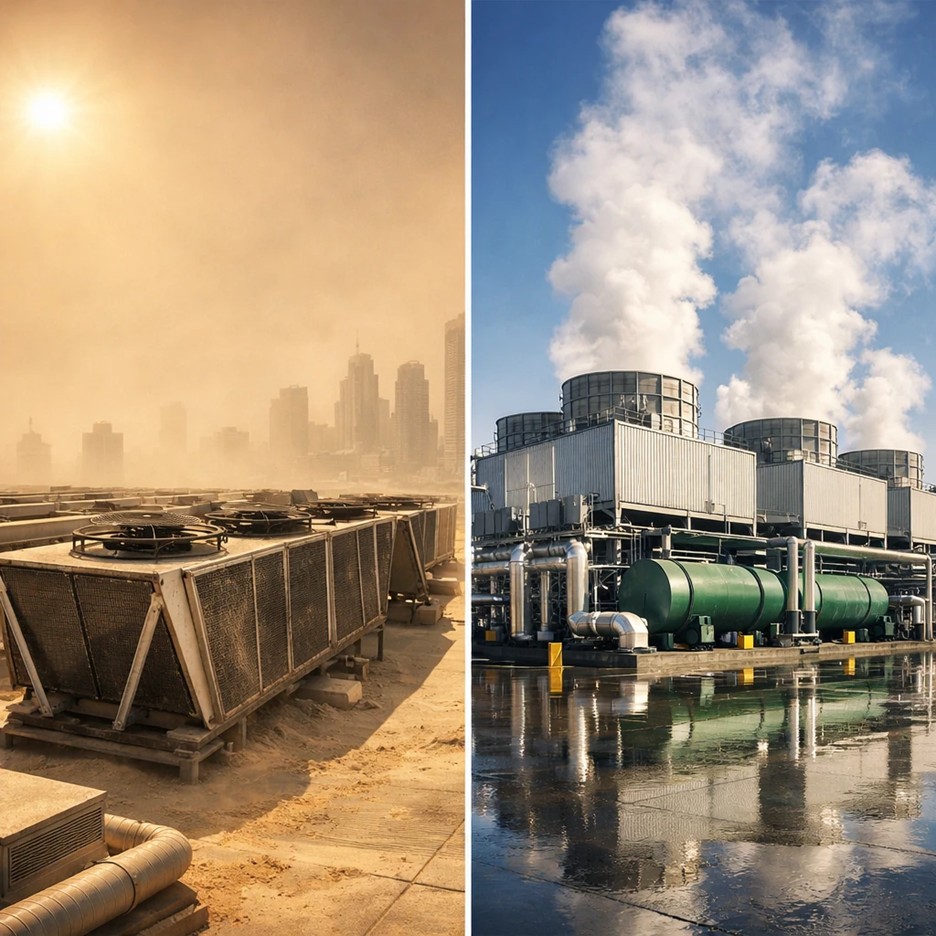
Choosing between an air‑cooled and water‑cooled chiller becomes a critical engineering decision in regions where summer temperatures exceed 45–50°C, humidity skyrockets in coastal zones, and cooling demand is nearly year‑round. Understanding the real‑world performance differences of air-cooled vs water-cooled chiller in hot climates helps facility managers, consultants, and building owners avoid costly design mistakes, unnecessary energy consumption, and premature equipment degradation.
In extremely hot regions—such as the GCC—the stakes are even higher. Here, chillers often represent 40–60% of the building’s total electrical load, and poor selection can drastically affect operational cost and cooling reliability.
This article provides an in‑depth engineering comparison of both systems, examining thermodynamic behavior, energy performance, maintenance needs, installation conditions, lifespan expectations, and cost efficiency—specifically tailored to hot climates.
Why the Middle East Requires a Different Approach to Chiller Selection
While many global HVAC guidelines focus on mild or temperate climates, the GCC belongs to what engineers classify as Extreme Climate HVAC conditions. Dust, sand, extreme dry heat, coastal humidity, and heavy continuous loads create unique operational challenges.
In these conditions:
- Condenser temperatures rise dramatically
- Efficiency ratings drop below nameplate values
- Cooling towers experience scaling and corrosion
- Air-cooled units suffer from high ambient derating
- Water-cooled units face microbiological growth and condenser fouling
These realities make it essential to deeply evaluate air-cooled vs water-cooled chiller in hot climates, rather than relying on generic HVAC recommendations from cooler climates.
How Air-Cooled Chillers Work in Hot Regions
Air‑cooled chillers reject heat directly to the outdoor air using axial or centrifugal fans. Their performance is heavily dependent on ambient temperature, which is often above 45°C in regions like Riyadh, Dubai, Kuwait, or Muscat.
Advantages of Air-Cooled Chillers in Hot Climates
- Lower installation complexity (no cooling tower)
- Less water usage—critical in arid regions
- Reduced Legionella risk
- Lower infrastructure footprint
- More suitable for medium-size buildings
Limitations
- Significant derating at high ambient temperatures
- Higher energy consumption due to hotter condenser conditions
- Increased noise levels
- Coil clogging due to sand and dust accumulation
- Lower long-term efficiency
To highlight this, according to ASHRAE,
“Air-cooled chillers typically exhibit lower efficiency in hot climates due to the elevated condensing temperature imposed by high ambient air.”
This is a direct confirmation of why air‑cooled units require careful derating and load consideration in hot climates.
How Water-Cooled Chillers Perform in Hot Climates
Water‑cooled chillers use cooling towers to maintain lower condensing temperatures than air‑cooled units can achieve in extreme outdoor conditions.
Advantages of Water-Cooled Chillers in Hot Regions
- Higher efficiency, especially in large systems
- More stable operation during heat waves
- Longer equipment life due to controlled temperatures
- Lower peak electrical demand
- Better performance in high‑rise and industrial facilities
Limitations
- Require cooling towers and more mechanical room space
- Higher water demand
- Risk of scaling, algae, biological growth
- More intensive maintenance requirements
Even in extremely hot climates, cooling towers can maintain condenser water temperatures significantly below ambient temperatures—something air‑cooled units cannot do. The U.S. Department of Energy supports this point:
“Water-cooled chillers are generally more efficient than air-cooled systems because they operate at lower condensing temperatures, especially in large commercial applications.”
This underscores their efficiency advantage in GCC conditions.
Thermal Performance Comparison in Hot Climates
To compare air-cooled vs water-cooled chiller in hot climates, you must understand how condenser temperatures drive system efficiency.
- Condensing Temperature
- Air-cooled: Condenser temperature ≈ ambient + 10–15°C
- Water-cooled: Condenser temperature ≈ 32–36°C (cooling tower)
With ambient air in GCC summers often >47°C, air-cooled chillers may operate with condensing temperatures exceeding 55–60°C, severely reducing EER and COP.
- Energy Efficiency Behavior
Water-cooled chillers generally deliver:
- 20–35% better full‑load efficiency
- Up to 40% better part‑load performance
- Greater stability during heat waves
- Reduced compressor stress
For projects requiring Energy-Efficient Chillers, water‑cooled systems nearly always outperform air‑cooled systems under GCC conditions.
Maintenance Requirements: A Realistic View
Maintenance can change the cost‑effectiveness of both systems significantly.
Air-Cooled Chiller Maintenance Needs
- Frequent cleaning of condenser coils
- Dust and sand removal
- Fan motor inspection
- Refrigerant pressure monitoring
- Vibration and noise checks
Water-Cooled Chiller Maintenance Needs
- Cooling tower basin cleaning
- Water treatment and anti‑scaling programs
- Microbiological growth prevention
- Tube brushing and chemical cleaning
- Pump and piping maintenance
Buildings in the Gulf often follow strict routines such as the chiller maintenance checklist in Dubai, which emphasizes both condenser health and seasonal heat‑load management.
The Risk of Condenser Fouling and Evaporator Damage
In harsh climates, both systems face unique risks; however, water-cooled units deal with more critical issues related to water quality.
This is where Chiller Evaporator Protection becomes vital. Scale, mud, biological fouling, and mineral deposits can drastically reduce heat transfer efficiency and increase compressor workload. Without proper water treatment:
- Tube conductivity drops
- Compressor amperage increases
- Chiller efficiency drops 10–25%
- Risk of evaporator burnout increases
Air-cooled units face fewer water quality issues but are extremely vulnerable to dust particles clogging condenser fins, leading to higher discharge pressures and system alarms.
Chiller Sizing for Extreme Heat
Accurate Chiller Sizing under high ambient conditions requires additional consideration:
- Derating factors for temperatures above 46°C
- Increased approach temperature at condenser
- Realistic part-load operation curves
- Humidity impact on cooling tower performance
Undersized chillers fail during peak summer hours. Oversized chillers short‑cycle and waste energy. GCC engineers often use real meteorological data (TMY files) to calculate sizing accurately.
Cooling Tower Challenges in Hot Climates
While water-cooled systems perform better thermodynamically, cooling towers introduce climate-specific challenges:
- Severe water evaporation loss
- Desert dust accumulation in basins
- Increased corrosion risk
- Reduced tower efficiency in humid coastal cities (e.g., Muscat, Jeddah)
Engineers often implement:
- Side-stream filters
- High-efficiency drift eliminators
- Automated chemical dosing
- Basin sweepers
These measures keep performance stable even during sandstorms.
Which System Is More Reliable for the GCC?
Best Uses for Air-Cooled Chillers
Ideal for:
- Medium-size commercial buildings
- Residential complexes
- Schools
- Projects where water is limited
- Rooftop installations with limited space
Best Uses for Water-Cooled Chillers
Ideal for:
- High-rise towers
- District cooling systems
- Malls and hospitals
- Industrial process cooling
- Projects prioritizing long-term energy savings
Water-cooled chillers dominate large-scale installations due to superior efficiency and durability in extreme temperatures.
Real-World Energy Cost Differences
Studies show that in GCC climates, water-cooled chillers can reduce annual energy bills by:
- 25–40% in commercial applications
- 15–30% in industrial processes
- Up to 50% with optimized tower controls + VFD pumps
Air-cooled chillers generally have:
- Lower upfront cost
- Higher yearly operating cost
- Slightly shorter lifespan
However, when maintenance is performed using professional routines such as the chiller maintenance checklist, both systems can achieve respectable reliability.
Environmental and Water Consumption Considerations
With rising sustainability standards, many projects must balance:
- Water usage (air-cooled wins)
- Electrical demand (water-cooled wins)
- Footprint constraints
- Noise regulations
- LEED or Estidama requirements
Governments in the GCC increasingly favor energy-efficient buildings, making water-cooled systems more attractive for long-term sustainability goals.
Final Engineering Comparison
Below is the most practical comparison for decision-makers evaluating air-cooled vs water-cooled chiller in hot climates.
Air-Cooled Chillers
Pros:
- Lower installation cost
- No water consumption
- Easier maintenance
- Smaller technical workforce required
Cons:
- Poorer performance in extreme heat
- Higher electrical consumption
- Shorter equipment lifespan
- Sensitive to sand and dust
Water-Cooled Chillers
Pros:
- Highest efficiency in hot climates
- Stable performance even in extreme temperatures
- Long lifespan
- Ideal for large buildings
Cons:
- Requires cooling towers
- High water usage
- Intensive maintenance
- Higher installation cost
Conclusion
In a detailed comparison of air-cooled vs water-cooled chiller in hot climates, the winner depends on project scale, water availability, maintenance capacity, and energy-cost priorities.
- For small and medium buildings, air-cooled chillers offer simplicity and lower upfront cost.
- For large commercial, industrial, or high-rise buildings, water-cooled chillers deliver dramatically better efficiency and reliability under extreme heat.
With proper sizing, proactive maintenance, and strategic system design, both chillers can perform well in GCC climates—but water-cooled systems generally offer superior performance where cooling demand is high and continuous.