
Articles
Condensing vs. Non‑Condensing Boilers: Which Is Right for You?

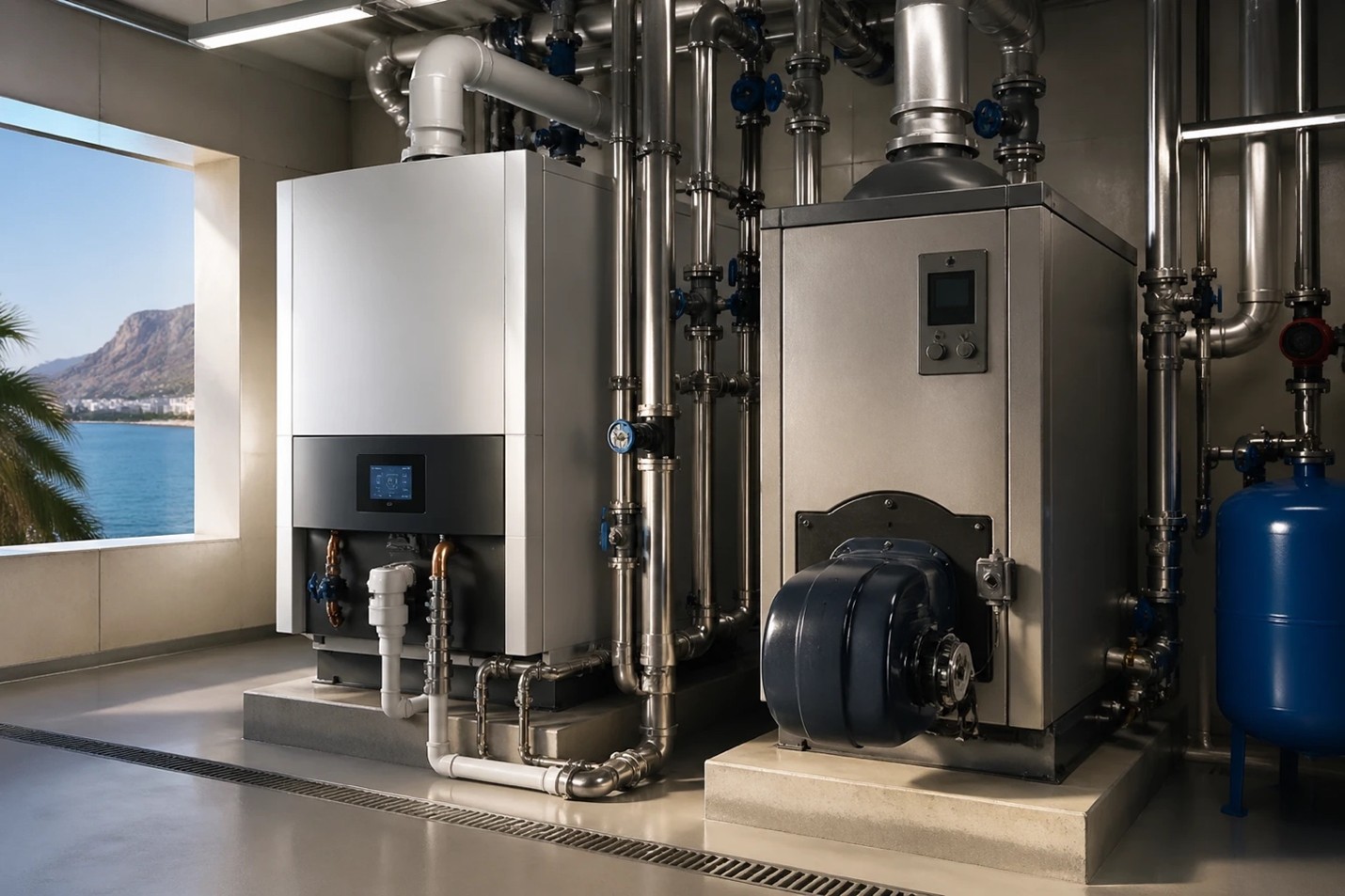
Choosing between Condensing vs. Non-Condensing Boilers in Muscat comes down to balancing long-term energy savings against upfront installation simplicity. If your priority is reducing high utility costs and achieving thermal efficiency of over 90%, a condensing boiler is the superior choice. However, for smaller properties or older buildings in coastal areas where specialized drainage for acidic condensate is difficult to install, a non-condensing unit remains a functional, though less efficient, alternative. This guide provides a definitive comparison tailored to the unique environmental demands of the Sultanate, ensuring your hot water and HVAC systems perform optimally in extreme heat.
Executive Overview: The Core Differences
| Feature | Condensing Boilers | Non-Condensing Boilers |
| Typical Efficiency | 90% – 98% | 70% – 80% |
| Heat Exchanger | Dual or oversized (Stainless Steel) | Single (Cast iron or Copper) |
| Flue Gas Temp | Approx. 50°C (Cooler) | Approx. 120°C – 200°C (Hotter) |
| Environmental Impact | Significantly lower CO2 emissions | Higher carbon footprint |
| Installation | Requires a drainage pipe for condensate | Standard flue exit only |
Understanding the Mechanics of Thermal Efficiency
To grasp the debate of Condensing vs. Non-Condensing Boilers, one must understand how energy is recaptured. In a traditional non-condensing system, a significant amount of heat is wasted. As fuel is burned, hot gases are produced and immediately vented through a flue to the outside. This is essentially “throwing away” energy that you have already paid for.
Condensing technology, however, utilizes a larger heat exchanger or sometimes two. This design allows the system to extract “latent heat” from the water vapor produced during combustion. By cooling the flue gases to the point where the water vapor turns back into liquid (condenses), the boiler recovers energy that would otherwise disappear into the Muscat sky. This process is particularly vital for large-scale residential complexes where hot water demand is constant.
The Impact of the Omani Environment on HVAC Selection
Living in a region with high ambient temperatures and significant salt spray requires a specific approach to mechanical engineering. When we discuss Extreme Climate HVAC solutions, we aren’t just talking about cooling; we are talking about how equipment handles thermal stress.
In Muscat, the high salinity of the air can lead to rapid corrosion of external components. Condensing boilers, which often feature high-grade stainless steel heat exchangers to handle the acidic nature of the condensate, are naturally more resilient to certain types of internal corrosion than the copper or cast-iron components found in older non-condensing models. However, the external housing must still be protected against the humid, salty breeze of the Sea of Oman.
Humidity and its Role in System Design
While boilers are primarily associated with heating water, they play a subtle but crucial role in integrated air handling systems. Effective Humidity Control in Coastal Climates HVAC design often relies on “reheat” cycles. In these systems, air is cooled significantly to strip out moisture and then slightly reheated to a comfortable delivery temperature.
In large commercial buildings or luxury villas in Al Mouj or Shatti Al Qurum, a high-efficiency condensing boiler provides the most cost-effective source for this reheat energy. By integrating high-efficiency boilers with advanced air handling units, engineers can maintain a dry, comfortable indoor environment without the astronomical electricity bills associated with purely electric heating elements.
Comparative Technical Analysis
To provide a deeper look into why one might choose one over the other, consider the following data points reflecting operational realities in the Middle East.
| Parameter | Condensing System | Non-Condensing System | Benefit of Condensing |
| Energy Loss | 2-10% | 20-30% | Massive fuel savings |
| Venting Material | Plastic (PVC/Polypropylene) | Metal (Steel/Aluminum) | Cheaper, corrosion-resistant venting |
| Carbon Footprint | Low (Eco-friendly) | High | Better for “Green Building” certs |
| Maintenance Need | Annual (Check condensate trap) | Annual (Standard) | Similar, but requires specific expertise |
As emphasized in a technical report by the Energy Saving Trust:
“Modern condensing boilers are now so efficient that they are the standard for any new installation looking to minimize carbon emissions and maximize energy return on investment.”
Installation Challenges in Muscat Properties
The primary hurdle when switching to a condensing model in existing Muscat structures is the “condensate pipe.” Because these boilers extract so much heat, the flue gases turn into a mildly acidic liquid. This liquid must be drained away into a waste pipe or a soakaway.
In many older villas, there is no easy access to a drain near the boiler’s location. This is where a professional HVAC troubleshooting guide becomes essential. An expert technician might need to install a small pump (a condensate pump) to move this liquid to the nearest drainage point. While this adds a small layer of complexity, the 20% to 30% reduction in gas or fuel consumption usually pays for this extra work within the first two years of operation.
Protecting the Core: Longevity and Reliability
For those managing larger facilities or industrial processes, boiler health is as critical as cooling health. We often focus on Chiller Evaporator Protection in the Middle East to prevent scaling and corrosion in cooling systems, but the same principles apply to the hot side of the HVAC spectrum.
Water quality in the Gulf can be “hard,” leading to limescale buildup inside the heat exchanger. Whether you choose Condensing vs. Non-Condensing Boilers, a water softener or a demineralization system is non-negotiable. For premium projects, working with established local experts like Filabico ensures that the system is not only installed correctly but also chemically treated to survive the harsh local water conditions. Without proper water treatment, a high-efficiency condensing boiler can lose its efficiency advantage in just a few months as scale acts as an insulator on the heat exchanger surfaces.
Operational Costs and Local Realities
In the Sultanate, where energy subsidies are gradually being restructured, efficiency is no longer a luxury—it is a financial necessity. A non-condensing boiler might be cheaper to purchase today, but it is effectively a “tax” on your future self. According to research conducted by ASHRAE:
“The selection of high-efficiency combustion equipment in hot climates is often overlooked, yet it remains one of the most effective ways to reduce the total life-cycle cost of building mechanical systems.”
When you factor in the high cost of maintenance in remote areas or the logistics of fuel delivery, the “install and forget” nature of a high-quality condensing unit becomes very attractive. The lower flue temperatures also mean that there is less heat stress on the surrounding structure and roof penetrations, which is a minor but notable benefit in the scorching Omani summer.
Technical Myths and Truths
There is a common misconception that condensing boilers only work with underfloor heating. This is false. While they are most efficient when the return water temperature is low (below 54°C), they are still significantly more efficient than non-condensing models even when used with traditional radiators or high-temperature fan coil units.
In the context of Condensing vs. Non-Condensing Boilers, it is important to realize that the “condensing” mode is a spectrum. Even if the system only “condenses” during 70% of its run-time, it is still vastly outperforming a non-condensing unit that wastes 25% of its energy 100% of the time.
Strategic Selection Criteria
When deciding which path to take, ask yourself these three questions:
- What is the intended lifespan of the building? For any structure intended to be used for more than 5 years, the fuel savings of a condensing unit outweigh the initial cost.
- Is there a nearby drain? If yes, go condensing. If no, factor in the cost of a condensate pump.
- What is the peak load? In industrial Muscat settings, where massive volumes of hot water are needed for laundry or food processing, the efficiency gap represents thousands of Rials per year.
The Future of Thermal Energy in Oman
As the Sultanate moves towards Vision 2040 and emphasizes sustainable urban development, the transition to high-efficiency appliances is inevitable. While the air conditioning system is the “lungs” of any Muscat home, the boiler is the “heart” of the hot water system. Choosing a condensing model is a proactive step toward a more sustainable and cost-effective household or business.
Modern systems now come with “smart” controllers that can adjust the firing rate of the boiler based on the outside temperature. In Muscat, where the temperature can swing from a humid 25°C at night to a blistering 45°C during the day, these modulating burners ensure that the boiler isn’t working harder than it needs to. This not only saves fuel but also extends the life of the internal components by reducing “short-cycling.”
Ultimately, the shift toward condensing technology reflects a broader understanding of mechanical harmony. By capturing every possible kilowatt of energy, we reduce the strain on our infrastructure and our wallets. Whether you are retrofitting a commercial kitchen in Ghala or building a new residence in Al Khoudh, the long-term logic points toward the more advanced, efficient, and environmentally friendly condensing option.