

Articles
HVAC Commissioning: Guaranteeing Performance from Day One


HVAC commissioning is the disciplined process that proves a heating, ventilation, and air conditioning system is not only installed, but ready to perform under real building conditions from the first day of operation. For project managers, contractors, and building owners, it turns HVAC from a completed scope item into a verified asset: tested, balanced, documented, handed over, and aligned with the owner’s operational goals.
| Key Point | What It Means for the Project |
|---|---|
| Main objective | Confirm that HVAC systems meet design intent and owner requirements |
| Best timing | Start during design, continue through installation, testing, handover, and early operation |
| Core activities | Documentation review, inspections, HVAC testing and balancing, functional performance tests, training |
| Business value | Better HVAC system performance, fewer defects, lower energy waste, smoother facility management |
| Long-term benefit | A stronger HVAC maintenance strategy built on verified baseline data |
What HVAC Commissioning Really Means
Commissioning is often misunderstood as a final inspection. In reality, it is a quality-assurance process that begins before equipment arrives on site. ASHRAE describes the commissioning process as a method for “achieving, validating, and documenting” facility performance against the owner’s objectives and criteria.
That distinction matters. A chiller may be installed correctly, an air handling unit may start, and a BMS screen may show “normal,” yet the building can still suffer from poor airflow, unstable temperatures, short cycling, excessive energy consumption, or unresolved control conflicts. Commissioning connects the dots between design, installation, controls, testing, documentation, and operation.
For commercial building systems, the goal is simple: the owner receives a building that works as intended, not a collection of equipment that merely turns on.
Why Day-One Performance Is a Commercial Issue
HVAC defects rarely stay technical. They become financial and operational problems. A poorly commissioned system can increase utility bills, trigger occupant complaints, reduce tenant satisfaction, shorten equipment life, and overload maintenance teams before the building has stabilized.
The U.S. Department of Energy notes that commissioning verifies whether a building performs according to its original design intent and helps identify deficiencies that may cause equipment failure, higher energy use, or poor indoor air quality.
- For owners, that means HVAC commissioning protects three outcomes at once: comfort, cost control, and operational reliability.
- For contractors, it reduces disputes by creating documented evidence that systems were tested against agreed criteria.
- For facility managers, it provides a clean starting point for future troubleshooting.
The Commissioning Process from Design to Handover
Strong building commissioning follows a sequence. Each stage has a specific role, and skipping one usually shifts risk to the end of the project.
1. Owner’s Project Requirements
The Owner’s Project Requirements, or OPR, define what success looks like. This may include indoor temperature ranges, humidity targets, ventilation requirements, redundancy expectations, energy efficiency goals, operating schedules, metering needs, and maintenance access requirements.
The Whole Building Design Guide explains that commissioning supports planning, design, installation, testing verification, documentation, and operation so facilities conform to the OPR.

2. Design Review
During design review, the commissioning authority checks whether drawings, specifications, sequences of operation, and equipment selections can realistically deliver the OPR. This is where many future defects can be avoided. For example, access clearance around valves, sensor locations, outside-air control logic, and balancing provisions should be confirmed before installation begins.
3. Installation Verification
Installation checks confirm that equipment, ductwork, piping, insulation, controls, dampers, valves, sensors, strainers, filters, and electrical connections match approved documents. This step is not just visual. It also checks maintainability: can the facility team replace filters, isolate equipment, clean coils, and access control panels safely?
4. HVAC Testing and Balancing
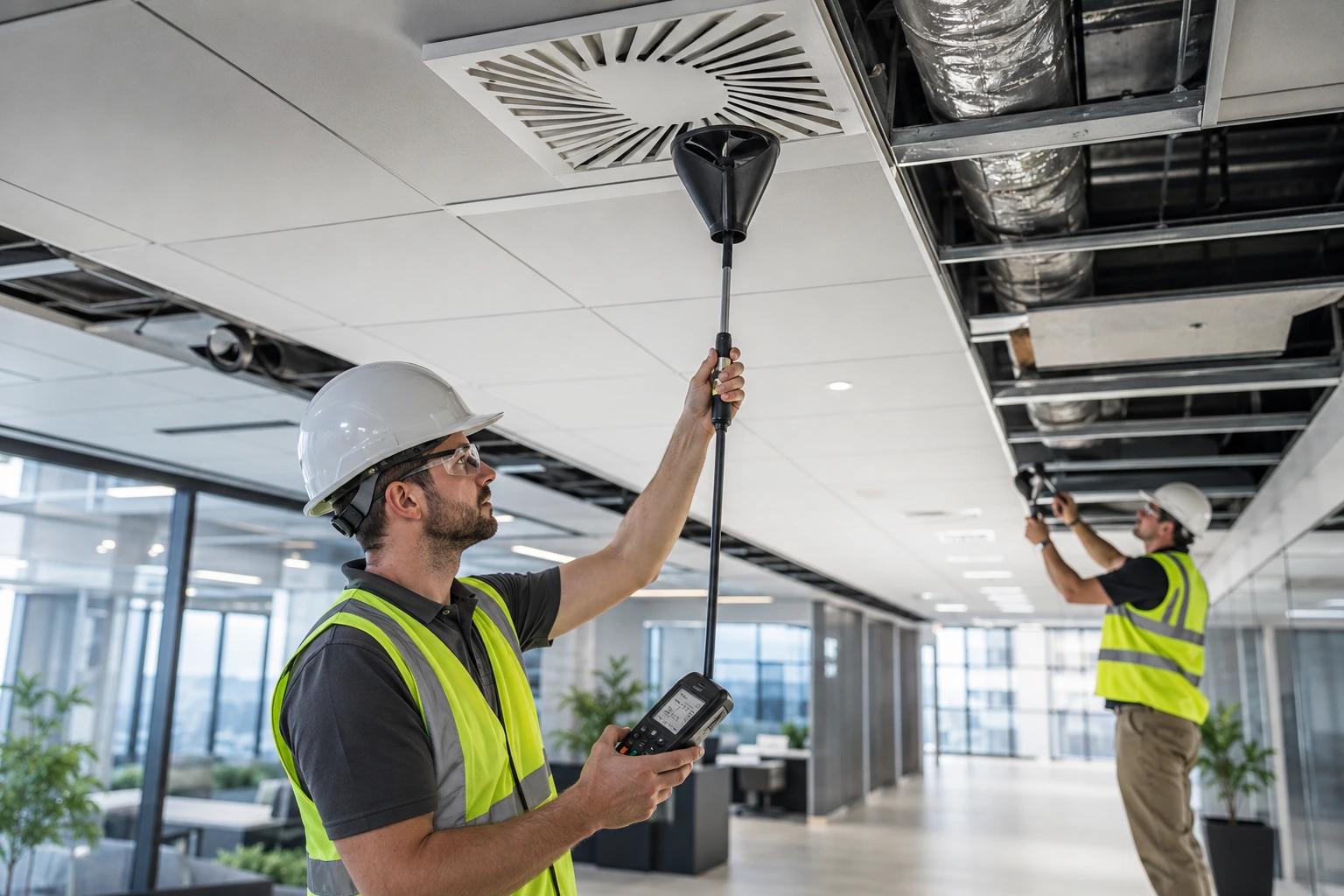
HVAC testing and balancing is where airflow and water flow move from design values to measured reality. Air terminals, diffusers, VAV boxes, pumps, chilled water loops, condenser water loops, and AHUs must be tested against specified values.
Balancing also reveals design or installation issues that may not appear during static inspection. Low airflow may be caused by duct leakage, undersized branches, incorrect damper positions, clogged filters, or poor fan control settings.
5. Functional Performance Testing
Functional testing proves the system responds correctly under different conditions. This includes start-up, shutdown, alarm response, temperature control, economizer logic, pressure control, lead-lag operation, emergency modes, and partial-load performance.
In a hot climate, a system that passes a basic start-up test in the morning may still fail under afternoon peak load. That is why performance testing must reflect actual operating conditions, not just ideal test conditions.
Commissioning Checklist for HVAC Systems
A commissioning checklist should be practical, project-specific, and tied to acceptance criteria. Generic templates help, but they should never replace engineering judgment.
| Commissioning Area | What to Verify | Evidence Required |
|---|---|---|
| Equipment installation | Model, capacity, orientation, access, vibration isolation | Inspection records and photos |
| Air systems | Fan rotation, filter condition, damper operation, airflow readings | TAB report |
| Hydronic systems | Pump rotation, valve position, flushing, flow rate, differential pressure | Pre-functional checklist and flow data |
| Controls | Sensor calibration, BMS points, alarms, trends, sequences | Controls verification report |
| Safety | Interlocks, emergency shutdown, smoke control interfaces where applicable | Functional test sheets |
| Documentation | O&M manuals, as-built drawings, warranties, training records | Final commissioning report |
For central cooling plants, a dedicated Chiller Commissioning Checklist Muscat can help align inspection, controls verification, chilled water balancing, and peak-load testing with local operating conditions.
Why Commissioning Improves Energy Efficiency
Energy efficiency is not achieved by efficient equipment alone. It depends on how the equipment is selected, installed, controlled, tested, operated, and maintained. A high-efficiency chiller connected to poorly balanced pumps or inaccurate sensors can waste energy every day.
Lawrence Berkeley National Laboratory reported that median primary energy savings for commissioning projects in existing buildings ranged from 5% to 14%, depending on program type and delivery method. The same research reported median simple payback of 1.7 years for existing-building commissioning.
Those savings often come from issues that look small in isolation: simultaneous heating and cooling, incorrect schedules, excessive outside air, stuck dampers, sensor drift, unstable static pressure control, or pumps operating at unnecessary speed.
Commissioning in Extreme Climates
In hot and humid regions, HVAC commissioning must be stricter because operating margins are smaller. Cooling loads are high, latent load control matters, and poor ventilation strategy can quickly affect comfort and indoor air quality.
For projects in Oman and the Gulf, Extreme Climate HVAC considerations should include condenser performance, filtration strategy, coil cleanliness, chilled water temperature reset, insulation integrity, condensate drainage, and controls response under peak ambient conditions. In Muscat, a specialist contractor such as Filabico can support owners by connecting commissioning results with realistic maintenance planning for local climate stress.
The Link Between Commissioning and Facility Management
The best commissioning process does not end at practical completion. It hands facility management teams the information they need to operate the building confidently.
A strong handover package should include:
- Final commissioning report
- Approved O&M manuals
- Controls narratives and point lists
- TAB results
- Seasonal testing requirements
- Training records
- Open issues log
- Recommended maintenance frequencies
- Baseline trend data from BMS
This documentation becomes the foundation of an HVAC maintenance strategy. Without it, facility teams inherit guesswork. With it, they inherit a measured baseline.
Owners evaluating lifecycle budgets should connect commissioning records with HVAC Maintenance Cost in Muscat, because verified baseline performance makes future maintenance planning more accurate and defensible.
Common Problems Commissioning Catches Early
Many HVAC problems are not caused by one major failure. They are caused by several small gaps that interact. Commissioning exposes those gaps before they become expensive.
Typical findings include incorrect sensor placement, reversed valve operation, uncalibrated thermostats, missing access panels, low chilled water flow, unstable VFD control, poor duct sealing, incomplete insulation, incorrect BMS graphics, missing alarms, and undocumented control overrides.
These issues are common because modern HVAC systems are integrated. Mechanical, electrical, controls, architectural, and operational decisions all affect final performance. Commissioning gives the owner an independent process to verify that these interfaces work together.
What Project Managers Should Demand
Project managers do not need to personally test every system, but they should insist on clear commissioning governance. The commissioning scope should be included in contracts, schedules, submittals, inspection plans, and handover requirements.
The most important requirements are:
- Commissioning authority appointed early
- OPR and Basis of Design documented
- Commissioning plan approved before installation
- Checklists linked to actual equipment and systems
- TAB completed before functional testing
- Controls contractor present during functional tests
- Defects tracked to closure
- Final report submitted before acceptance
This structure prevents commissioning from becoming a rushed paperwork exercise at the end of construction.
Turning Commissioning into Long-Term Performance
Day-one performance is only the first milestone. Buildings change. Tenants move in, operating schedules shift, filters load, sensors drift, setpoints get overridden, and maintenance practices evolve. That is why the best owners treat commissioning as the beginning of operational discipline.
Seasonal testing, trend reviews, fault detection, recommissioning, and periodic controls audits help preserve performance. The Whole Building Design Guide notes that commissioning supports efficient, safe, and healthy facilities while improving documentation, operations, staff training, and life-cycle performance.
In practical terms, commissioning gives owners a verified baseline. Facility management keeps that baseline alive.
Performance That Starts Before Occupancy
HVAC commissioning is not an optional technical formality. It is the process that protects the owner’s investment before the first tenant complaint, first summer peak, or first high utility bill. When it is planned early and executed properly, it confirms that commercial building systems are installed correctly, tested under meaningful conditions, and ready for long-term operation.
A building that performs from day one is rarely the result of luck. It is the result of clear requirements, disciplined testing, accurate documentation, and a commissioning process that treats HVAC performance as a measurable business outcome.