

Articles
VRF vs chiller for Doha high-rises

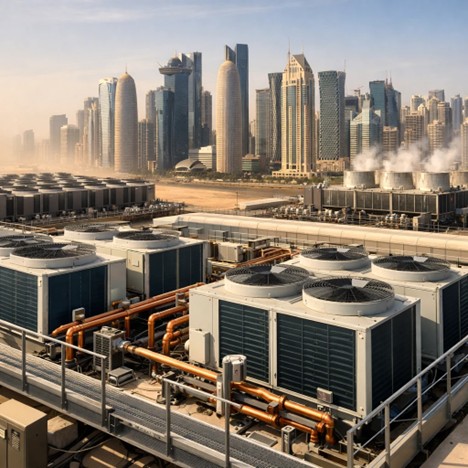
When developers and consultants design new towers in West Bay, Lusail, or The Pearl, one technical question keeps coming back: VRF vs chiller for Doha high‑rises—which solution really makes more sense under Qatar’s extreme climate, dense urban fabric, and strict efficiency targets?
On paper, both VRF and chiller systems can deliver high comfort and flexible zoning. But once you factor in Doha’s scorching summers above 45°C, mixed‑use occupancy patterns, and future expansion needs, the differences become much sharper. The wrong choice doesn’t just waste a few kilowatt‑hours; it can lock the building into decades of elevated operating costs, complex maintenance, and dissatisfied tenants.
In this article, we will analyze VRF vs chiller for Doha high‑rises from an engineering and lifecycle perspective, including:
- Energy efficiency under peak Gulf summer conditions
- Vertical distribution challenges in tall buildings
- Maintenance complexity and reliability
- Space constraints on roofs and technical floors
- Water usage and sustainability considerations
- Total cost of ownership over 15–20 years
The goal is not to pick a universal winner, but to give you an evidence‑based framework for making the right choice for real projects in Doha.
Climate and High-Rise Context: Why Doha Is Unique
Any comparison of VRF vs chiller for Doha must start with climate and building typology.
Doha combines:
- Very high dry‑bulb temperatures in summer, above 45°C
- High solar loads on façades and roofs
- Strong cooling demand almost all year round
- Rapidly developing skyline with tall towers and complex podiums
- Growing pressure for energy codes, green buildings, and ESG reporting
High‑rises in such environments present special challenges:
- Large vertical height → higher static pressures and pump/fan energy
- Mixed occupancies (offices, retail, hospitality, residential) → complex load profiles
- Critical requirements for redundancy and continuous operation
In other words, we’re not just choosing between two technologies in a vacuum; we’re choosing a long‑term HVAC backbone for some of the most demanding buildings in the region.
How VRF Systems Behave in GCC Towers
Variable Refrigerant Flow systems have become very popular across the GCC, especially for small to medium buildings and premium apartments. A single outdoor unit (or a network of them) serves multiple indoor units, each with its own capacity modulation.
From a VRF Systems GCC point of view, the key strengths are:
- Excellent zoning and individual temperature control
- High part‑load efficiency when designed correctly
- Compact indoor units with flexible routing
- Less invasive installation for fit‑out and refurbishment
However, tall towers in Doha put VRF under specific stress:
- Refrigerant line length and vertical separation
High‑rises quickly hit the maximum allowable vertical separation and overall piping length specified by VRF manufacturers. This can force complex cascade configurations and multiple VRF “islands,” increasing design and maintenance complexity.
- High ambient temperatures
In summer, rooftop condensers see very high ambient air temperatures. As ASHRAE notes:
“High outdoor air temperatures reduce the capacity and efficiency of air‑cooled DX equipment, requiring careful selection and derating in hot climates.”
This is crucial when many VRF outdoor units are clustered on crowded roofs, with limited airflow and strong solar gain.
- Maintenance accessibility
Dozens of outdoor units and hundreds of indoor units scattered across a tower create a distributed maintenance challenge. Access to riser shafts, ceiling voids, and roof zones must be meticulously planned.
- Refrigerant charge and safety
With large refrigerant volumes running through occupied spaces, designers must respect safety standards and maximum charge per zone, especially in residential and hospitality applications.
VRF is powerful, but in very tall towers with heavy and continuous cooling loads, its advantages can be partially offset by these constraints.
Chillers in Doha High-Rises: Centralized Powerhouses
Chiller‑based systems—usually with chilled‑water AHUs and FCUs—are the traditional backbone of high‑rise cooling across the Gulf. They can be either air‑cooled or water‑cooled, with different implications for energy, water, and space.
A previous comparison of air-cooled vs water-cooled chiller in hot climates clearly shows that water‑cooled chillers tend to outperform air‑cooled machines in big projects when carefully engineered and maintained. However, both can be used in Doha towers depending on plot constraints, water availability, and developer preferences.
Key strengths of chillers in high‑rise applications:
- Centralized plant, easier to monitor and control
- Large capacity machines with high full‑load and part‑load efficiency
- Chilled water is safe, non‑flammable, and easy to distribute vertically
- Integration with sophisticated BMS and energy metering is straightforward
- Better scalability for future expansion, especially in mixed‑use complexes
Chiller plants also allow more flexibility in advanced Chiller Sizing. Designers can stage multiple chillers, apply N+1 redundancy, and optimize capacity distribution according to realistic load profiles instead of simply matching nameplate capacities.
The U.S. Department of Energy emphasizes the role of chillers in large commercial buildings:
“Chillers often represent the single largest electric load in a commercial building, so optimizing their selection and operation can yield substantial energy savings.”
This statement reinforces why, for major towers in Doha, chiller plant design is a strategic decision rather than a purely technical one.
Distribution and Vertical Transport: Water vs Refrigerant
One of the most practical differences in VRF vs chiller for Doha high‑rises is the nature of the distribution medium:
- VRF: distributes refrigerant vertically and horizontally
- Chiller plant: distributes chilled water via risers and branches
In tall towers, chilled water has several advantages:
- Pumps handle static head more predictably than refrigerant compressors dealing with long vertical lifts.
- Chilled water risers are robust, easy to insulate, and relatively simple to balance hydraulically.
- Safety is better understood: any leakage is water, not refrigerant.
VRF distribution becomes more complex as height increases, especially when dealing with multiple mechanical floors, podiums, and rooftop amenities. For this reason, many engineers still favor central chillers for towers above a certain height or cooling load, while VRF often dominates low‑rise and mid‑rise buildings.
Energy Efficiency: Part-Load Reality vs Nameplate Ratings
Both VRF and chillers can be marketed as Energy-Efficient Chillers or high‑efficiency DX systems, depending on which manufacturer you talk to. The real question is: under Doha’s climate and actual usage patterns, which technology holds its efficiency better?
- VRF shines at part‑load conditions with excellent modulation and zoning. In office towers with varied occupancy and many intermittently used spaces, this can be a major advantage.
- Chiller systems, especially with variable primary flow, high‑efficiency pumps, and optimized controls, also achieve very strong part‑load performance—in particular when paired with modern BMS and demand‑based control strategies.
In practice, the most efficient system is usually the one:
- Properly sized (not over‑ or under‑designed)
- Equipped with high‑quality controls
- Professionally commissioned and maintained
In many Doha high‑rise case studies, modern chiller plants with optimized controls often reach or exceed VRF efficiency, especially once the system operates under continuous heavy loads for much of the year.
Maintenance, Reliability, and Evaporator Protection
From an O&M perspective, a tower filled with VRF indoor units and distributed outdoor units presents a different risk profile than a central chiller plant.
- VRF: many small compressors, electronic expansion valves, controllers, and PCBs distributed throughout the building.
- Chiller plant: fewer large machines, pumps, and centralized AHUs/FCUs.
A central plant concentrates risk into fewer pieces of equipment—but those machines are large and critical. Here, concepts such as Chiller Evaporator Protection become crucial. Fouling, poor water treatment, and lack of flow control can cause serious efficiency losses and even catastrophic failures.
For example, without good water treatment:
- Heat transfer is reduced by scale and biofilm
- Chiller energy consumption can increase by 10–20%
- Tube failures and leaks become more likely
On the other hand, a VRF system avoids water circuit problems but can suffer from:
- Difficult fault tracing when many connected indoor units are involved
- Complex PCB and communication issues
- Access challenges for indoor units in finished ceilings
The ideal scenario in Doha is not “zero maintenance” but smart maintenance—predictive and scheduled, with proper diagnostics. Whether you choose VRF or chillers, a robust maintenance regime is non‑negotiable for long‑term performance.
Space, Aesthetics, and Urban Constraints
In dense districts of Doha, roof and podium space are extremely valuable. The choice between VRF vs chiller for Doha towers is heavily influenced by:
- Available roof area for outdoor units or cooling towers
- Architectural requirements (visible equipment, noise, vibration)
- Structural loading limits on roofs and technical floors
VRF:
- Requires multiple outdoor units, which may clutter façades and roofs
- Can be more flexible in retrofits where central plant space is limited
Chillers:
- Require a dedicated plant room and, for water‑cooled systems, cooling towers
- Offer a more centralized and visually controlled solution in master‑planned developments
Decisions at concept design stage must integrate architects, structural engineers, and MEP consultants to avoid last‑minute compromises that harm both efficiency and aesthetics.
Integration with HVAC Concepts and Future Flexibility
At the conceptual level, it helps to remember the difference between hvac and vrf system:
- HVAC is the broader domain: heating, ventilation, and air conditioning solutions and strategies.
- VRF is one specific DX technology within the HVAC universe, just as chillers are another central plant technology.
For Doha high‑rises, long‑term flexibility often favors chilled‑water systems:
- Easier to extend risers and add new AHUs/FCUs in refurbished floors
- Compatible with future central plants, district cooling, or hybrid systems
- More straightforward to integrate advanced filtration and ventilation upgrades at AHU level
VRF systems can also be extended, but at some point, manufacturer limits and refrigerant safety constraints become the bottleneck.
When VRF Wins and When Chillers Win in Doha Towers
Putting it all together, a realistic guideline for VRF vs chiller for Doha high‑rises might look like this:
VRF is usually preferable when:
- The building is low‑rise or mid‑rise, not a super‑tall tower
- Zoning complexity and individual tenant control are top priorities
- Roof space is limited but façade integration is possible
- Developer prioritizes lower initial cost over maximum long‑term efficiency
- Water infrastructure for cooling towers is not available or not desired
Chiller systems are usually preferable when:
- The project is a tall high‑rise or a cluster of towers on a shared podium
- Cooling loads are large and nearly continuous (offices, hospitality, mixed‑use)
- The developer targets long‑term operational efficiency and ESG metrics
- There is space for a central plant and possibly cooling towers
- Integration with district cooling is planned or considered for the future
No single answer fits all, but for flagship towers and large mixed‑use developments in Doha, properly designed chiller plants still tend to be the reference solution.
Conclusion
The decision between VRF vs chiller for Doha high‑rises is not about which technology is “modern” or “traditional,” but about how each solution fits the climate, geometry, usage profile, and long‑term strategy of the building.
- VRF delivers excellent controllability and high part‑load efficiency, especially in small to medium buildings or premium apartments.
- Chiller systems provide a robust, scalable backbone for very tall towers and large complexes, with strong efficiency potential and well‑understood central maintenance.
For Doha’s skyline, where high‑rises must withstand extreme heat, evolving energy regulations, and demanding occupants, the most successful projects are those where the MEP team evaluates both options rigorously from the very first concept sketches, instead of defaulting to a familiar template.