


Articles
AHU Maintenance Checklist in Riyadh (Monthly / Quarterly)

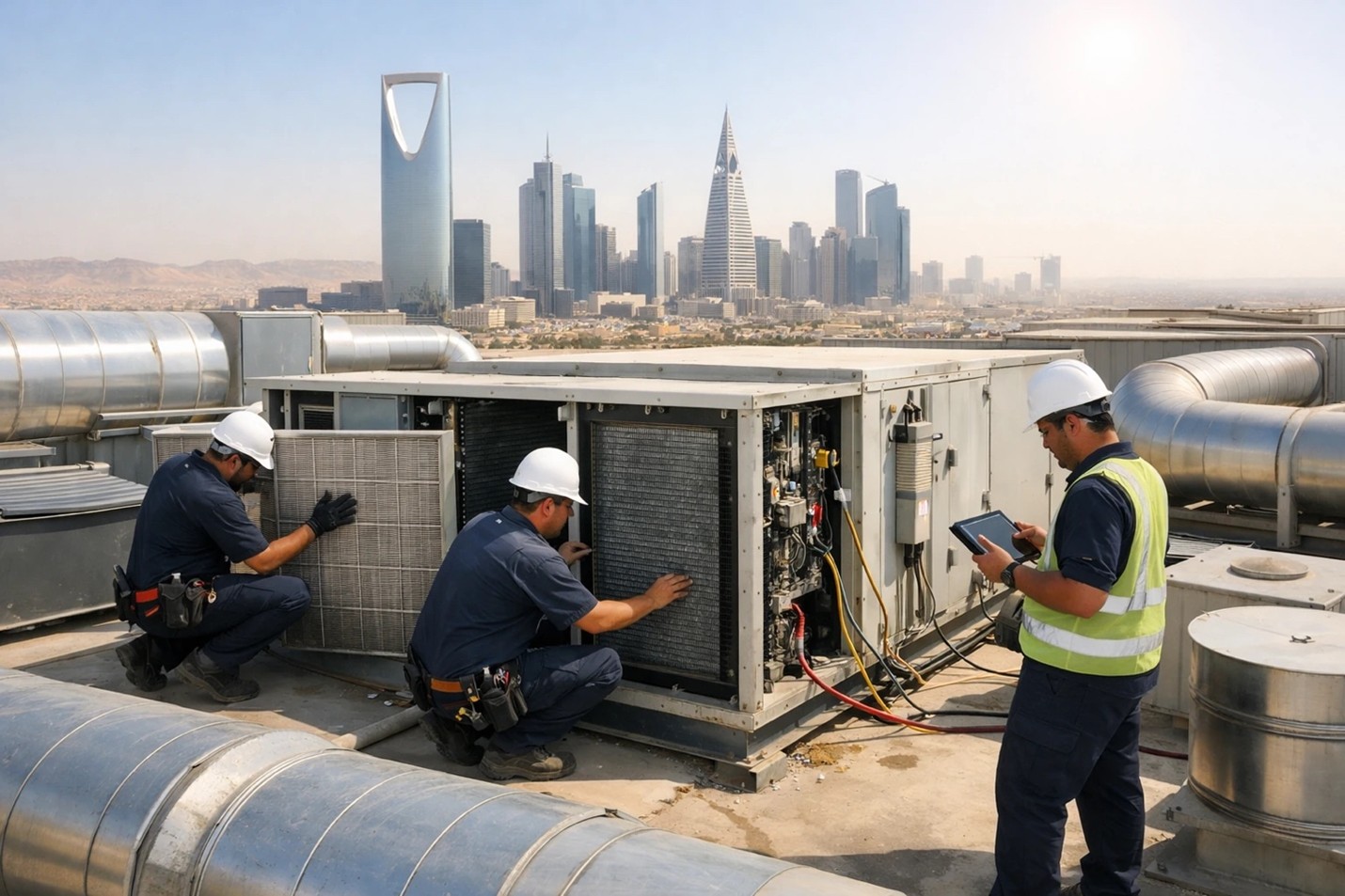
If your building in Riyadh struggles with inconsistent cooling, high energy bills, or air quality complaints, the solution often begins with a reliable AHU maintenance checklist in Riyadh. In a city where temperatures frequently soar above 45°C and cooling systems run nearly nonstop, a structured maintenance routine is the only way to keep HVAC performance stable and prevent sudden failures. If you’re a facility manager, technician, or building owner searching for a clear framework that actually solves your real‑world problems—not just generic advice—you’re exactly where you should be.
Riyadh’s climate creates extreme workloads for Air Handling Units (AHUs). Constant dust, severe heat, and heavy cooling demand make AHUs the backbone of comfort inside hospitals, malls, commercial towers, industrial facilities, and even luxury residences. Without an organized preventive maintenance approach, even modern HVAC systems can lose efficiency rapidly.
This guide provides a complete and actionable AHU maintenance checklist in Riyadh, covering monthly and quarterly tasks, operational insights, performance strategies, and benchmarks. You won’t need to search another site after reading this—every potential question a facility manager might have is answered here.
Why AHU Maintenance Matters More in Riyadh Than Most Other Cities
Riyadh belongs to what HVAC engineers classify as an Extreme Climate HVAC zone—where cooling systems endure harsh conditions year‑round. Sandstorms introduce fine particles that clog filters and reduce airflow. High ambient temperatures put additional stress on fans, motors, sensors, and coils. And because buildings rarely get seasonal downtime from cooling operations, AHUs often run far above global averages. Poor AHU maintenance in this environment leads to:
- Sharp increases in electricity consumption
- Reduced indoor air quality
- Early mechanical failures
- Inconsistent temperature delivery
- Unpredictable breakdowns during peak demand
To reinforce this, according to the U.S. Department of Energy:
“Replacing or cleaning filters, maintaining airflow, and inspecting system components are essential to ensure HVAC systems maintain their efficiency and deliver proper indoor comfort.”
This quote captures exactly why Riyadh buildings need structured AHU routines rather than reactive repair calls.
Understanding the Role of AHUs in Large Facilities
Before diving into the checklist, it’s important to understand why AHUs matter so much. Air Handling Units pull air from outside or return zones, filter it, condition it through cooling coils, regulate humidity, and distribute it across indoor spaces.
A typical AHU includes:
- Filters
- Cooling coils
- Blowers
- Dampers
- Sensors and actuators
- Control boards
- Drain pans and pumps
When even one component becomes inefficient—such as a clogged filter or a malfunctioning damper—the entire system’s performance drops. That’s why deep, consistent inspections are critical in the Gulf.
Monthly AHU Maintenance Checklist
A strong AHU maintenance checklist in Riyadh should start with monthly inspections. These keep the system stable and catch early‑stage issues before they evolve into costly failures.
Monthly tasks include:
- Inspect and replace filters if airflow is restricted
- Check fan belts for tension, wear, or cracks
- Verify coil condition and remove visible dust buildup
- Inspect damper operation and linkage alignment
- Measure airflow and static pressure levels
- Clean drain pans and ensure proper drainage
- Confirm sensor readings (temperature, humidity, pressure)
- Review BMS logs for AHU alarms and irregularities
Monthly maintenance is especially important in regions with heavy dust. Riyadh often faces sandstorms that fill filters prematurely—waiting three months would severely impact airflow.
Quarterly AHU Maintenance Checklist
Quarterly tasks go deeper, focusing on parts that affect efficiency and long‑term reliability. A comprehensive quarterly inspection includes:
- Deep cleaning of cooling coils
- Lubricating motor bearings
- Checking alignment of blower wheels
- Inspecting electrical connections
- Testing damper actuators
- Measuring temperature differential across coils
- Cleaning fresh air sections and outdoor intake grilles
- Calibrating humidity and temperature sensors
One of the most overlooked quarterly tasks is airflow balancing. Over time, dampers drift from their set positions, and airflow distribution becomes uneven. Balancing helps restore uniform cooling across the building.
Where Many AHU Failures Begin: Humidity, Airflow, and Coil Fouling
While Riyadh is primarily a hot‑dry climate, buildings still struggle with humidity levels—especially facilities connected to surrounding Gulf operations. When HVAC systems are used in coastal locations, additional moisture affects coil surfaces and indoor conditions.
The principles used in Humidity Control in Coastal Climates HVAC Muscat apply here too. Excess humidity can cause microbial growth on coils, reduce cooling capacity, and trigger musty odors. Even in Riyadh, improper humidity management can strain AHUs.
Airflow problems are another leading cause of performance loss. When coils become dirty, the pressure drop increases, forcing fans to work harder. This raises energy consumption and reduces cooling output.
Maintenance Table: A Practical Reference for Facility Managers
Here is a concise and useful table you can integrate into your operations for fast reference:
| AHU Component | Monthly Action | Quarterly Action | Importance |
| Filters | Inspect & replace | Deep cleaning of housing | Maintains airflow & IAQ |
| Cooling Coils | Surface cleaning | Chemical cleaning | Ensures heat transfer efficiency |
| Fans & Belts | Check tension | Full alignment | Reduces vibration & noise |
| Dampers | Test movement | Check actuators | Ensures proper ventilation rates |
| Sensors | Verify readings | Full calibration | Improves system accuracy |
| Drain System | Clean & flush | Inspect pump | Prevents water overflow & mold |
This table gives operational clarity and ensures teams never miss a critical step.
How AHU Maintenance Links to Overall HVAC Efficiency
An AHU never operates alone. It works alongside chillers, pumps, ducts, and BMS systems. If any of these components struggle, AHU performance also drops. Many facility managers already follow a chiller maintenance checklist in Dubai, but they often neglect the AHU—even though both systems depend on each other for proper cooling.
For example:
- A poorly maintained chiller produces warmer chilled water
- Warmer water reduces AHU coil cooling capacity
- AHUs compensate by increasing airflow, which raises energy usage
Thus, AHU maintenance cannot be isolated—it is part of a whole‑building strategy.
Smart Monitoring: The Future of AHU Maintenance
Modern buildings increasingly rely on Smart HVAC IoT technologies to automate performance monitoring. IoT sensors track airflow, filter pressure drops, vibration levels, and humidity in real time—alerting technicians automatically when something deviates from normal ranges. According to ASHRAE,
Continuous monitoring and predictive analytics have become essential tools in detecting HVAC equipment faults before system performance declines.
This type of insight is especially valuable in Saudi Arabia, where the cost of system downtime is extremely high for hospitals, data centers, and industrial operations.
Common Questions Users Ask About AHU Maintenance
- How often should AHUs be serviced in Riyadh?
Monthly inspections and quarterly deep service are ideal. Dust conditions may require more frequent filter changes.
- What is the most important AHU component to maintain?
Filters and coils. They have the greatest impact on airflow and cooling performance.
- How do I know if my AHU is losing efficiency?
Signs include increased energy usage, weak airflow, temperature fluctuations, and unusual noises.
- Does AHU maintenance reduce electricity consumption?
Yes—dirty coils, clogged filters, and misaligned fans force the system to work harder, increasing energy usage significantly.
- Do I need professional technicians?
Yes. While basic inspections can be done in‑house, tasks like coil chemical cleaning and sensor calibration should be handled by certified professionals.
- What role do AHUs play in humidity control?
AHUs regulate moisture through cooling coils and fresh‑air dampers. Poor maintenance leads to humidity imbalance.
- Can AHU issues affect chiller performance?
Absolutely. Poor airflow makes cooling coils inefficient, increasing chilled water return temperatures and forcing chillers to work harder.
Smart Connection: AHUs, Chillers, and System Design
When designing HVAC systems in Riyadh, proper Chiller Sizing plays a critical role. Undersized or oversized chillers create inconsistency in AHU cooling delivery. A perfectly maintained AHU cannot compensate for incorrectly sized chillers.
That’s why many engineering consultancies in the Gulf—including firms like filabico operating in Muscat—use integrated HVAC analysis to ensure AHUs and chillers are perfectly matched for desert conditions.
Real‑World Problems Prevented by Routine AHU Maintenance
- Dust accumulation leading to motor overheating
- Mold growth caused by ignored drain pans
- High indoor humidity from malfunctioning dampers
- Warm air complaints due to dirty coils
- Increased operating cost from clogged filters
- Electrical failures caused by loose terminals
These problems are preventable when following a structured maintenance routine.
Conclusion
Riyadh’s climate demands more from HVAC systems than almost any other region in the world. Air Handling Units are central to air quality, cooling performance, humidity control, and comfort—yet they are among the most overlooked components in HVAC maintenance.
By following a structured AHU maintenance checklist in Riyadh, facility managers can:
- Improve cooling performance
- Reduce energy bills
- Extend equipment lifespan
- Prevent emergency breakdowns
- Maintain consistent indoor comfort
With the right tools, smart monitoring, and professional oversight, AHUs can operate efficiently even in the intense climate of Riyadh.