


Articles
HVAC Contractors in Oman: Muscat Service & Retrofit

If you’re searching for hvac contractors in oman, the fastest way to avoid wasted budget is to choose a team that designs for Muscat’s heat and humidity, commissions properly, and supports you with structured HVAC maintenance—not just repairs after a breakdown.
| What to evaluate in Muscat | What “good” looks like | Why it matters |
|---|---|---|
| Extreme-weather readiness | High-ambient planning, anti-corrosion measures | Keeps cooling stable in peak season |
| Commissioning discipline | Test-and-balance, controls verification, handover | Prevents comfort complaints and drift |
| Maintenance capability | Scheduled PM, coil/drain care, reporting | Lower energy bills, fewer surprises |
| Troubleshooting speed | Data-driven HVAC troubleshooting, fault history | Faster recovery, less downtime |
| Solution breadth | Ducted splits, VRF, rooftop, chillers, AHUs | Best-fit system per building type |
| After-sales structure | Spares readiness, response SLAs, site coverage | Reliability for commercial sites |
Why Muscat demands a higher contractor standard
In Muscat, HVAC systems run long hours under conditions that magnify small problems: dusty air loads filters faster, coastal humidity challenges dehumidification, and high ambient temperatures raise condenser pressures and power draw. This is why extreme climate HVAC thinking isn’t optional—it is the baseline for dependable operation.
The difference between “an installer” and a true contractor shows up quickly in real buildings. If commissioning is weak, you get hot spots, hunting thermostats, frequent cycling, and rising electricity use. If maintenance is inconsistent, coils foul, drains block, and failures arrive at the worst time—midday, mid-summer, when technicians are busiest.
What services top Oman HVAC contractors should cover
The best oman hvac companies offer end-to-end capability. That matters because the lifecycle is where costs and risks live: selection, installation quality, commissioning, and ongoing care.
A capable contractor should be able to support:
-
Design support and equipment selection based on actual loads and occupancy patterns
-
Proper installation practices (drain routing, insulation integrity, electrical termination, access clearances)
-
Commissioning: airflow, controls, sequences, alarms, and setpoint logic
-
Preventive service programs designed around local conditions, not generic intervals
This breadth is particularly important in hvac companies in muscat that serve mixed portfolios—villas, offices, retail, clinics, industrial sites—where one-size solutions fail.
The Muscat “performance killers” contractors should manage
Most underperformance in Oman doesn’t start with “bad equipment.” It starts with predictable field issues:
Dirty coils and filters
A lightly fouled coil can reduce heat transfer and force compressors to work harder. Over time, energy use rises and cooling feels weaker.
Condensate drainage and humidity control
Humidity is a comfort issue and a building-protection issue. Poor drainage design or maintenance can cause odors, water damage, and shutoffs.
Controls drift and schedule mistakes
Many complaints trace back to setpoints, occupancy schedules, or sensors—not refrigerant.
Airflow imbalance
Even strong equipment cannot fix a poorly balanced system. Air distribution problems create persistent hot and cold zones, especially in ducted systems.
These are exactly the areas where structured HVAC maintenance prevents emergency calls.
Why maintenance is a selection criterion, not an add-on
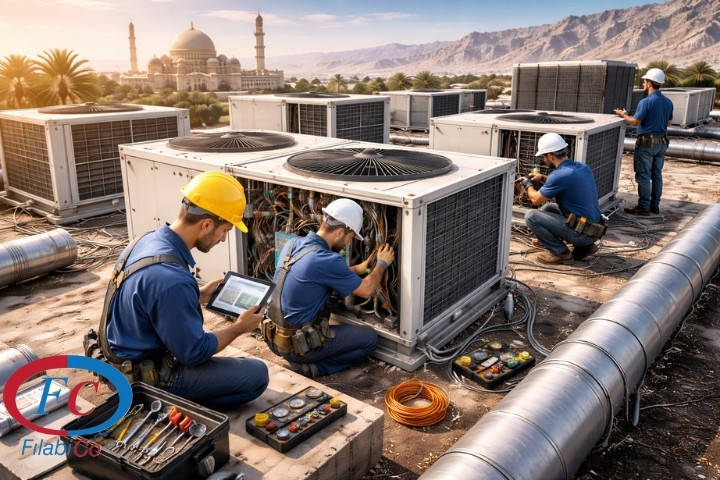
Before listing what to ask a contractor, it’s worth being blunt: in Oman, maintenance is part of the system design. If your contractor can’t deliver a reliable service plan, you’re effectively buying uncertainty. According to the U.S. Department of Energy:
“Regular maintenance of your air conditioner’s filters, coils, fins, and refrigerant lines is essential for efficient and effective performance.”
That statement matters for Muscat owners because filters, coils, and drains are where the climate hits first. A serious contractor builds maintenance access into the design, then follows a documented schedule after handover.
What to ask hvac contractors in oman before you sign
Use these questions to separate polished sales talk from operational capability. These checks are especially useful if you are also comparing air conditioning companies in oman for multi-site support.
-
How do you size and select equipment for high-ambient conditions, and what assumptions do you use for load and diversity?
-
What commissioning steps will you document (airflow readings, control sequences, alarm tests, sensor checks)?
-
What is your coil and drain maintenance method, and how often do you recommend it in Muscat’s dust and humidity?
-
How do you structure emergency response versus scheduled service, and what reporting do you provide after each visit?
-
For commercial buildings, how do you reduce energy use without destabilizing comfort and humidity control?
A contractor who answers with specific methods, checklists, and measurements is typically safer than one who answers with general promises.
Choosing systems that fit Oman buildings
Oman’s building stock is diverse, so contractors should be comfortable with multiple system types, and clear about where each is strongest:
- Ducted split systems: Often a good fit for villas and smaller commercial floors where zoning, aesthetics, and moderate loads apply. The contractor’s duct design and balancing quality matter as much as the equipment.
- VRF systems: Useful when you need high zoning flexibility and part-load efficiency across varied occupancy patterns. Controls and maintenance quality are critical for long-term stability.
- Rooftop packages: Practical for quick deployment and service access, especially in retail and industrial applications. Proper placement, filtration, and weather protection drive performance.
- Chillers and air handling units: Typical for larger commercial and healthcare facilities where ventilation control and central plant management are priorities. Commissioning and ongoing monitoring are essential.
A strong contractor will explain the “why” behind each recommendation—especially in Muscat, where a wrong fit becomes expensive.
Air quality in healthcare and sensitive environments
For clinics, hospitals, laboratories, and high-occupancy spaces, ventilation and filtration quality matter as much as cooling capacity. Contractors should understand pressure relationships, filtration grades, humidity targets, and how to keep systems clean without compromising performance. If the site has healthcare requirements, you want a contractor that can align HVAC design decisions with Healthcare Air Quality expectations—while still keeping energy use under control.
Why smart monitoring is becoming standard in Oman
Oman facilities increasingly want visibility: alarms, trend logs, energy signals, and remote diagnostics. That’s where Smart HVAC IoT approaches shift HVAC operations from reactive to predictive—especially valuable for commercial portfolios. According to Daikin:
“In the air conditioning market, we will provide new value by combining utilization of air conditioning equipment operation data, energy management, and IAQ technologies.”
For owners, this translates into fewer blind spots: you catch performance drift earlier, prioritize maintenance smarter, and reduce downtime risk during peak season.
Where Filabico fits in the Muscat contractor landscape
If your goal is to work with a partner that covers design support through long-term care, Filabico positions itself as an engineering-led HVAC provider with over 40 years of experience across the GCC, supporting projects from concept and design to installation and lifetime maintenance.
In practical terms, this kind of model matters in Oman because it ties together the full chain of success: selection, procurement, installation quality, commissioning, and site-ready service support. Filabico also highlights a broad equipment and application scope—chillers, air handling units, boilers, rooftop packages, fan-coils, and specialized solutions for healthcare and industrial environments—so system choice can match the building instead of forcing the building to match a limited catalog.
A simple decision framework for Muscat owners
Most problems with hvac contractors in oman happen when selection is based only on upfront price. A more reliable approach is to rank candidates on outcomes:
- Can they maintain comfort and humidity under peak conditions?
- Can they document commissioning and provide measurable handover?
- Can they deliver maintenance that preserves efficiency and reliability?
- Can they troubleshoot quickly with evidence, not guesswork?
- Can they support your building type—residential, retail, healthcare, industrial—without outsourcing critical steps?
If you apply that framework, the best contractor often becomes obvious: they may not be the cheapest quote, but they will usually be the lowest-cost option over the life of the system.
Closing perspective
In Muscat, HVAC is infrastructure. The best hvac contractors in oman operate like engineering partners: they plan for extreme conditions, commission thoroughly, and support you with disciplined maintenance and fast troubleshooting. When you evaluate contractors through that lens—service structure, commissioning discipline, climate readiness, and long-term support—you’ll end up with a system that stays efficient and dependable long after the handover.