

Articles
Extreme Climate HVAC: Solutions for Hot and Cold Regions

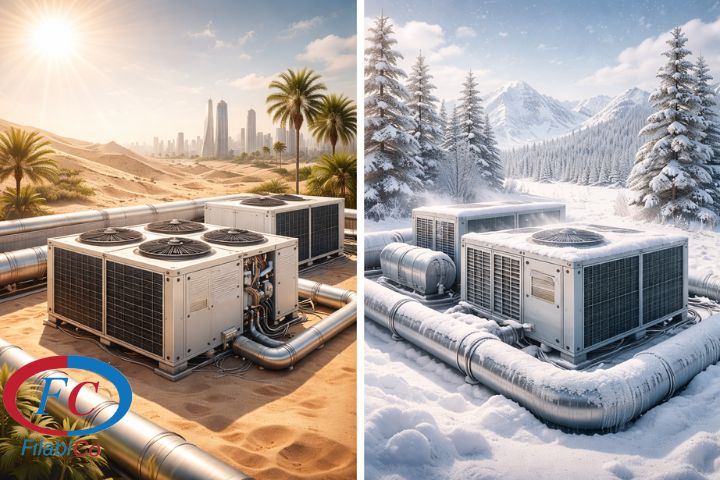
Designing extreme climate HVAC systems is one of the most demanding challenges in building engineering. Whether the problem is relentless desert heat or prolonged sub-zero winters, HVAC systems in extreme climates must deliver reliable comfort, protect equipment, and remain energy-efficient under conditions that quickly expose design weaknesses. This article explores how HVAC systems behave in hot and cold extremes, what design strategies work, and which operational practices keep systems stable over the long term.
HVAC Solutions for Extreme Climates: Hot and Cold
| Climate Challenge | HVAC Risk in Extreme Conditions | Engineering Solution | Practical Outcome |
|---|---|---|---|
| Extreme heat | High condensing pressure, capacity drop | High-ambient rated equipment, condenser optimization | Stable cooling at peak temperatures |
| Extreme cold | Coil and pipe freezing | Glycol loops, preheat coils, freeze protection controls | No freeze damage, reliable heating |
| Large temperature swings | Control instability, short cycling | Adaptive control logic, staged capacity | Longer equipment life |
| Dust & sand | Coil fouling, airflow reduction | High-efficiency filtration, coil protection | Maintained efficiency |
| Snow & ice | Blocked airflow, fan damage | Elevated units, snow guards, defrost logic | Continuous operation |
| Long peak seasons | Continuous full-load operation | Redundancy (N+1), load diversity | Reduced downtime |
| Harsh environment wear | Accelerated component failure | Corrosion-resistant materials | Lower lifecycle cost |
| Limited maintenance windows | Delayed fault detection | Monitoring & diagnostics | Faster HVAC troubleshooting |
| Health-sensitive spaces | Poor air quality under stress | Enhanced ventilation & filtration | Protected healthcare air quality |
| Hot-region operations | High energy penalties | Climate-specific design strategy | Efficient commercial HVAC Oman systems |
Why extreme climates push HVAC systems to their limits
In moderate climates, HVAC systems can rely on predictable seasonal patterns. In extreme environments, however, systems face prolonged stress. High ambient temperatures increase condensing pressures and electrical load, while extreme cold threatens freezing, material fatigue, and control instability. In both cases, small design mistakes are amplified.
Extreme climate HVAC design must address:
- Continuous operation near design limits
- Large temperature differentials between indoor and outdoor air
- Dust, sand, humidity, snow, or ice depending on geography
- Higher risk of mechanical wear and control failures
Without climate-specific engineering, even high-quality equipment can underperform or fail prematurely.
Understanding hot-climate HVAC challenges
Hot climates—such as deserts and coastal regions with high humidity—create a unique combination of thermal and environmental stress. Cooling systems must reject heat to already-hot ambient air, reducing efficiency and increasing compressor workload.
Key hot-climate challenges include:
- Elevated condensing temperatures that reduce cooling capacity
- Higher electrical demand during peak daytime hours
- Dust and sand fouling coils, filters, and fans
- Humidity control requirements that increase latent loads
Engineering firms specializing in hot-region systems emphasize the need for customized solutions. According to NY Engineers:
“Custom engineered HVAC units are often required in extreme climates to ensure reliable performance where standard equipment may struggle.”
This highlights an important principle: in extreme heat, standard catalog selections are rarely enough.
HVAC performance in extreme cold environments
Cold climates present a different set of problems. Heating systems must operate efficiently while protecting water-based components from freezing and maintaining stable airflow despite snow and ice accumulation.
Common cold-climate risks include:
- Frozen coils, piping, and condensate drains
- Reduced airflow due to snow blockage or ice formation
- Brittle materials and seal failures at low temperatures
- Control instability during rapid temperature swings
Technical education sources note that weather extremes directly affect HVAC reliability. According to RSI University:
“Extreme weather conditions can cause HVAC systems to work harder than designed, increasing wear and the likelihood of component failure.”
This observation applies equally to heat waves and cold snaps: systems pushed beyond their comfort zone degrade faster.
Core design principles for extreme climate HVAC
Successful extreme climate HVAC systems share a set of foundational design principles that apply regardless of whether the challenge is heat or cold.
1. Accurate load calculations
Design loads must reflect realistic worst-case conditions, not average weather data. In hot climates, this means accounting for solar gain and humidity. In cold regions, infiltration and wind effects become dominant.
2. Equipment derating awareness
Manufacturers publish performance data showing how capacity drops at high or low ambient temperatures. Ignoring this leads to undersized systems that fail exactly when they are needed most.
3. Redundancy and resilience
Extreme climates leave little margin for error. N+1 redundancy, staged capacity, and backup heating or cooling sources are essential for mission-critical buildings.
4. Controls tuned for extremes
Control logic must prevent short cycling, freezing, or excessive compressor loading. This is where advanced monitoring and adaptive algorithms play a key role.
System selection strategies in hot regions
In persistently hot climates, system choice directly affects energy use and reliability. Designers often favor solutions that minimize duct losses and allow flexible zoning.
Ducted Split Systems are commonly used where space constraints or phased construction make large central plants impractical. Properly designed, they offer zoning flexibility and reduced duct heat gain compared to large centralized systems.
For larger commercial buildings, chilled-water systems remain popular, but they require careful condenser selection, water treatment, and coil protection to survive dusty, high-temperature environments.
In regions such as the Gulf, commercial HVAC Oman projects increasingly focus on equipment rated for very high ambient temperatures and long operating hours, rather than peak efficiency numbers alone.
Cold-climate HVAC strategies that work
In cold environments, protecting the system is as important as providing heat. Design strategies typically include:
- Glycol loops or freeze-protected heat exchangers
- Preheat coils to temper incoming outdoor air
- Enclosed or indoor air-handling equipment
- Intelligent defrost cycles for heat pumps
These measures prevent catastrophic freezing while maintaining acceptable energy performance.
Maintenance as a survival strategy
In extreme climates, HVAC maintenance is not just about efficiency—it is about survival. Systems exposed to dust storms, heat waves, or ice accumulation degrade rapidly without structured care.
Effective maintenance programs emphasize:
- Frequent filter inspection and replacement
- Coil cleaning schedules tied to local conditions
- Seasonal control testing before peak periods
- Early detection of abnormal pressures, temperatures, or vibration
Proactive maintenance reduces the likelihood of emergency failures during the most demanding conditions.
Troubleshooting in extreme conditions
Extreme environments make fault diagnosis more complex. Symptoms that look minor in mild climates can escalate quickly under stress.
Structured HVAC troubleshooting in extreme climates focuses on identifying root causes rather than symptoms. For example, high head pressure in hot weather may indicate coil fouling rather than refrigerant overcharge. In cold climates, airflow alarms may be linked to ice buildup rather than fan failure.
Using trend data and alarms allows operators to act before comfort or safety is compromised.
Air quality considerations under extreme conditions
While thermal control is often the primary concern, air quality cannot be ignored. In healthcare and sensitive facilities, maintaining Healthcare Air Quality becomes more challenging when outdoor air is extremely hot, cold, dusty, or polluted.
Design responses include:
-
High-efficiency filtration to manage dust and particulates
-
Controlled ventilation rates to balance fresh air and energy use
-
Humidity control strategies to prevent microbial growth
These measures ensure that extreme climate HVAC systems protect both comfort and occupant health.
The role of intelligent controls and monitoring
Modern extreme climate HVAC systems increasingly rely on advanced controls and analytics. Continuous monitoring allows operators to see how systems behave under stress and adjust strategies in real time.
Benefits include:
-
Early warning of capacity shortfalls
-
Adaptive setpoints during heat waves or cold snaps
-
Data-driven decisions about maintenance and upgrades
Intelligent systems transform HVAC from a reactive utility into a managed, resilient infrastructure.
Long-term performance and lifecycle thinking
Extreme climates accelerate wear, making lifecycle cost far more important than initial capital cost. Systems designed only for minimum compliance often incur higher operating and replacement costs over time.
Lifecycle-focused extreme climate HVAC design prioritizes:
- Durable materials and corrosion-resistant components
- Serviceable layouts that simplify maintenance
- Energy efficiency across a wide operating range
This approach reduces total cost of ownership and improves reliability.
Bringing it all together
Designing HVAC systems for extreme heat and cold requires more than scaling up standard solutions. It demands climate-specific engineering, robust controls, disciplined maintenance, and a deep understanding of how systems behave under prolonged stress.
By combining accurate load analysis, resilient system selection, proactive maintenance, and intelligent monitoring, extreme climate HVAC systems can deliver reliable comfort and safety—even in the harshest environments.