


Articles
Smart HVAC IoT: modern climate control for buildings

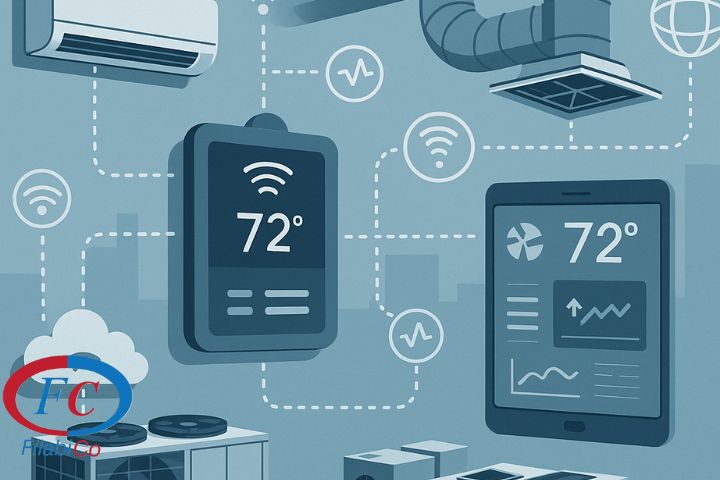
In busy commercial buildings, comfort complaints and energy bills often rise together. Smart HVAC IoT uses connected sensors, controllers and cloud software to keep spaces comfortable with less energy, fewer breakdowns and much better visibility for facility teams.
What smart HVAC + IoT actually does
| Focus area | What IoT adds to HVAC | Result for building owners |
|---|---|---|
| Real-time visibility | Continuous data from sensors on temperature, IAQ and equipment | Faster fault detection, fewer surprises |
| Automation & control | Cloud dashboards, mobile apps, smart controllers | Stable comfort with less manual tweaking |
| Predictive maintenance | Analytics on trends, runtime and alarms | Fewer outages, lower lifecycle costs |
| Energy optimization | Data-driven tuning of setpoints and schedules | Lower kWh, smaller carbon footprint |
| Occupant experience | Fine room-level control and better air quality | Happier tenants, more attractive buildings |
What smart HVAC and IoT really mean
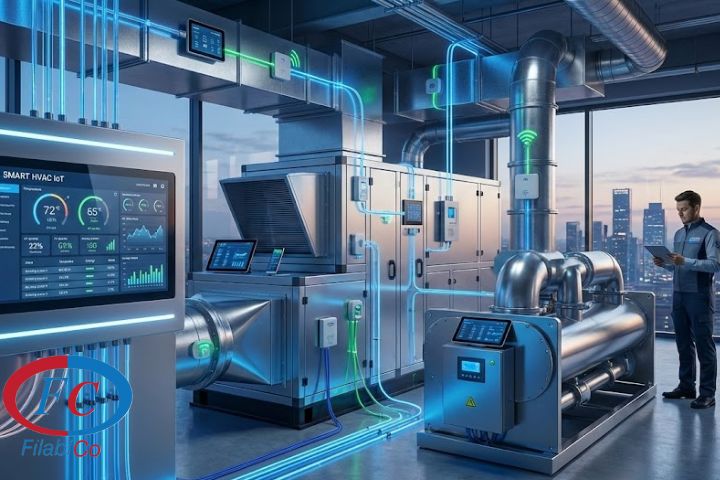
Many people hear “smart” and think only of phone apps, but smart HVAC IoT is more than that. It links HVAC equipment, field sensors and cloud platforms into one system, so your plant is constantly telling you how it feels instead of staying silent until something fails.
A smart platform typically gathers data on temperature, humidity, CO₂, volatile organic compounds, pressure, vibration and power use, then turns that data into alerts, trends and optimization rules. Articles from IoT specialists describe how a smart HVAC setup integrates networked components and IoT technologies as a natural evolution of traditional building automation systems, giving occupants much finer control over their indoor climate while improving efficiency.
According to SmartHVAC:
“The smartHVAC solution enables buildings and facilities owners to effectively monitor and respond to the IAQ Environment using the latest Sensor and Wireless Technologies.”
That combination of live environmental data plus secure connectivity is the foundation for everything else you can do with smart HVAC.
How IoT changes day-to-day HVAC operations
Traditional HVAC often runs on a simple loop: follow a static schedule, react to thermostat calls, wait for complaints or alarms. With IoT, climate control becomes much closer to real-time collaboration between the building and your operations team.
Industry guides from Particle explain that when HVAC is connected, contractors and owners can see performance data as it happens, not weeks later on an energy bill.
According to particle.io website,
“Using the IoT to link HVAC systems helps manufacturers, contractors, and end users monitor their performance and detect issues before they become major outages.”
In practical terms, that means:
- You see coils starting to foul, fans drawing more power or compressors short-cycling long before tenants feel discomfort.
- Alerts can be prioritized, so your technicians go first to the sites and units that truly need attention.
- Data from multiple buildings in a portfolio can be compared, revealing where setpoints or schedules need tuning.
When this connected HVAC technology is working well, the system almost feels alive: it reports what is happening in every major unit, and your team responds with targeted adjustments instead of guesswork.
Practical benefits for owners and facility managers
From a business perspective, the case for IoT-enabled climate control usually comes down to three pillars: energy, uptime and comfort.
First, energy. IoT platforms track how much power equipment uses at different loads and conditions. By combining this with weather data and occupancy patterns, they help optimize schedules, temperature deadbands, fan speeds and chiller loading. Industry case studies show that IoT-enabled monitoring can significantly reduce unnecessary “truck rolls” and wasted kWh while improving compliance with efficiency standards.
Second, uptime. Instead of waiting for something to break, you can spot anomalies—rising power consumption, abnormal vibration, unusual on/off patterns—and intervene before there is a full outage. This shifts your strategy from reactive to predictive and condition-based care.
Third, occupant experience. When rooms actually stay within a narrow comfort band and air quality is visible and managed, complaint calls fall and lease renewals get easier. This is especially important in high-value spaces such as offices, clinics, hotels, schools and data rooms.
For owners planning long-term portfolios, smart HVAC systems also protect asset value: modern, connected plant is easier to document, certify and integrate with future building technologies.
Key building blocks of smart HVAC IoT
It is easy to get lost in buzzwords, so it helps to break the architecture into a few simple layers before you start designing or upgrading a project.
At a high level, smart HVAC IoT solutions usually include:
- Field layer: Sensors for temperature, humidity, CO₂, particulates, pressure, flow and power, plus intelligent controllers built into chillers, AHUs, VRF systems and rooftop units.
- Connectivity layer: Secure wired or wireless networks that move data from field devices to gateways and then to the cloud or on-premises servers.
- Platform layer: Cloud or local applications that store data, visualize performance, run analytics and push commands back to equipment.
On top of that, you still need well-designed plant and ducts: IoT cannot fix undersized coils or badly balanced systems. What it does is give you the information and control you need to get the best out of your physical equipment.
For operators already investing in structured HVAC maintenance, IoT becomes a force multiplier. It tells you which assets deserve attention now, which can wait, and which are working harder than they should.
Why IoT matters so much in Oman and the GCC
In Oman and the wider GCC, HVAC systems carry a heavy load: long cooling seasons, high ambient temperatures, coastal humidity and frequent dust events. Any technology that improves visibility, control and efficiency has outsized impact because the baseline energy use is so high. Smart platforms help in several Middle-East-specific ways:
- They show how heat and airflow behave across large, sun-exposed façades and deep floor plates.
- They reveal how dust and air-quality events affect filters and coils, helping you time cleaning and replacement to real conditions rather than fixed dates.
- They make it easier to manage chilled-water plants, VRF, and rooftop units across mixed portfolios of malls, offices, villas and industrial sites.
For owners and consultants who are actively choosing Oman HVAC partners, this is no longer a “nice to have” feature. It is a serious differentiator: can your supplier design, integrate and support connected solutions that stand up to Gulf conditions over the long term?
Filabico, for example, emphasizes over 40 years of experience delivering smart, reliable and energy-efficient HVAC solutions from concept to commissioning across commercial, residential and industrial projects in Oman and the GCC, with a strong focus on innovation and lifecycle value.
From idea to reality: how to start integrating IoT
To turn high-level ideas into working projects, it helps to move in phases rather than trying to make everything “smart” at once. Start with a clear business goal—lower energy, fewer breakdowns, better tenant experience—and work backwards.
Before rolling out a full platform, most successful teams:
- Select a pilot building or critical asset (for example, a main chiller plant or a flagship office floor) where benefits will be obvious and measurable.
- Install a focused set of sensors and gateways, then test dashboards and alerts with the operations team and your integration partner.
- Use lessons from the pilot—data quality, network reliability, user training—to design a scalable template for the rest of the portfolio.
Along the way, remember that cyber-security, IT integration and change management are just as important as the hardware. A connected system must be secure, manageable and understandable for the people who actually run the building every day.
When the approach is right, IoT HVAC deployments stop being experiments and become part of your standard design and operations playbook.
Connecting the dots: design, operations and strategy
The biggest payoff from smart HVAC IoT appears when you align design, operations and long-term strategy rather than treating IoT as a bolt-on gadget.
Design-wise, you specify equipment that exposes the right data points and can accept remote commands. Operationally, you tune alarms, dashboards and workflows so technicians are guided by data instead of drowning in it. Strategically, you use the insights to plan upgrades, negotiate service contracts and demonstrate performance to investors, tenants and regulators.
At this point, you are not just looking for the Right HVAC System for Your Commercial Building; you are designing an information system around your mechanical plant so that every kWh and every maintenance hour is used more intelligently.
In day-to-day work, the line between climate control and IT will continue to blur. That is a good thing: as HVAC and IoT converge, buildings become easier to run, cheaper to heat and cool, and more pleasant to occupy.