


Articles
Autoclave Sterilizer HVAC & Ground Support Equipment for Aviation and Healthcare

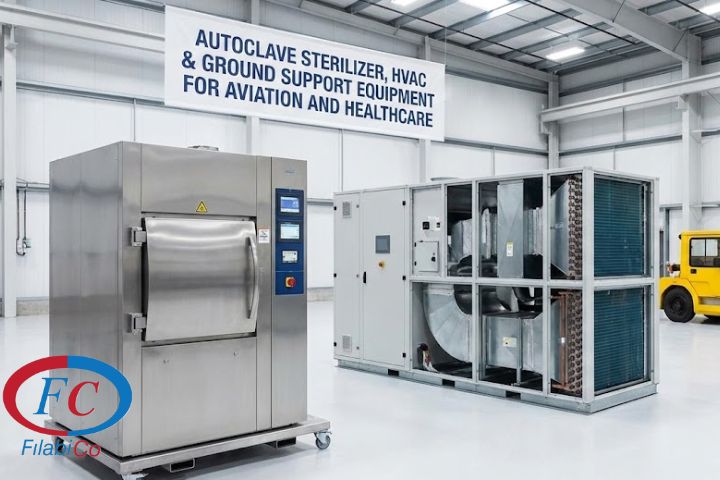
When you design HVAC projects for airports or hospitals, you are not just sizing chillers and air handlers. You also have to make sure that ground support equipment (GSE) and autoclave sterilizers are fed, cooled, ventilated and maintained correctly. That is where a focused autoclave sterilizer HVAC strategy becomes essential.
Where GSE and Autoclaves Touch Your HVAC Design
| Element | Typical location | What HVAC must provide |
|---|---|---|
| Mobile ground support equipment | Apron, hangars, service bays | Power, cooling air, exhaust extraction, filtration |
| Fixed GSE (PCA, GPU rooms) | Technical rooms, building roof | Ventilation, heat rejection, noise control |
| Clinical autoclave sterilizers | CSSDs, labs, infection-control hubs | Make-up air, steam/condensate, heat removal |
| Industrial autoclaves | MRO shops, industrial labs | Ventilation, pressure relief, robust extraction |
| Central plant & ductwork | Chiller room, AHUs, risers | Capacity for process loads plus comfort cooling |
What “autoclave sterilizer HVAC” really means in projects
In practice, autoclave sterilizer HVAC is shorthand for everything the building needs to keep sterilizers operating safely and efficiently: steam or electric power, cooling water or chilled water, ventilation to manage heat and moisture, and reliable condensate and exhaust handling.
For example:
-
A hospital central sterile services department (CSSD) needs carefully balanced supply and extract air so that autoclave doors can open without dumping steam into corridors.
-
A maintenance, repair and overhaul (MRO) shop at an airport might use large industrial autoclaves to cure composites or sterilize tools, adding significant process heat to the HVAC load.
-
Both spaces must maintain pressure relationships and temperature/humidity setpoints that support infection control and staff comfort.
If you ignore these loads in early design, you end up with hot, humid rooms, tripping equipment and a central plant that constantly feels undersized.

Autoclave sterilizers: from clinics to industrial users
Modern autoclaves are no longer simple “black boxes” at the edge of the HVAC design. They are precise, high-temperature, high-pressure machines whose performance depends on the environment around them. Clinical suppliers such as Celitron describe how compact autoclaves for dental veterinary and small clinics combine high steam parameters with short, efficient cycles to handle wrapped instruments, cassettes and small loads. According to celitron.com,
“any load coming out of the Sting 11B benchtop autoclave will be 100% sterile and safe to use again.”
On the industrial side, manufacturers like Infitek offer vertical Class N and Class B autoclaves in volumes from bench-top units up to large floor-standing machines, with working temperatures typically in the 116–134 °C range and multi-stage drying options.
For you as an HVAC designer or owner, the message is clear: sterilizers vary widely in size and duty, but all of them reject heat and moisture that your ventilation and cooling systems must manage.
Where ground support equipment meets HVAC design
In aviation projects, ground support equipment includes everything from pre-conditioned air (PCA) units for parked aircraft to ground power units (GPU), tow tractors and maintenance stands. Some of these are self-contained mobile units; others tap into central chillers or air systems.
From an HVAC perspective, there are three recurring interfaces:
-
Pre-conditioned air and bleed-less aircraft
PCA systems may draw chilled water from the central plant or use packaged DX equipment. Either way, they add significant load to the plant during aircraft turnaround. Your chiller and pump selections must include realistic diversity factors for these GSE demands. -
GSE workshops and MRO spaces
Hangars and workshops where GSE is repaired need good general ventilation plus local exhaust for engine testing and battery charging. When autoclaves are used to sterilize tools, PPE or lab equipment, their steam and cooling requirements must be integrated into the same HVAC backbone. -
Technical rooms and shelters
Fixed GSE—like centralized PCA or GPU rooms—often sits in compact technical spaces. These rooms concentrate a lot of heat in a small volume and require dedicated extract, make-up air and sometimes small comfort-cooling units to protect electronics and power components.
If you are choosing Oman HVAC solutions for an airport or MRO facility, all of these loads need to appear in your block loads and equipment schedules, not just in a late-stage “specialist equipment” note.
HVAC implications of autoclaves in healthcare projects
Healthcare autoclaves do more than sterilize instruments; they shape your infection-control and ventilation strategy. CSSDs, operating-theatre back-of-house areas and isolation units all rely on correct pressurization and air change rates.
Before listing design tips, it helps to remember that these spaces are usually mission-critical: if autoclaves stop, surgery schedules and lab workflows are at risk.
In that context, good design typically addresses:
-
Sufficient make-up air so sterilizers do not depressurize rooms when they discharge steam to drains or flash off condensate.
-
Thermal loads from jacket heating, door gaskets and drying cycles, which must be captured by extract air or local cooling coils.
-
Robust drainage and condensate routing to prevent hot condensate from damaging floors or plumbing before it cools.
Because sterilizers are process equipment, they also influence service corridors, door sizes and maintenance clearances—details that must be coordinated with ductwork and piping layouts.
Integrating autoclaves and GSE into industrial HVAC equipment choices
When you select industrial HVAC equipment for a complex site, autoclaves and GSE should appear on the same design page as chillers, air handlers and exhaust systems. Their power and cooling requirements can affect:
-
Central plant capacity and redundancy
-
Duct sizes and routing for exhaust and make-up air
-
Space planning for plant rooms and technical corridors
Owners who already follow best practices for HVAC maintenance quickly see the value of bringing these loads into their planned service routines as well. Sterilizers and GSE often run at high duty cycles and benefit greatly from coordinated shutdown windows, filter changes and performance checks alongside the main HVAC assets.
Filabico, for example, specializes in delivering complete HVAC systems for commercial, residential and industrial buildings in Oman, covering everything from initial design to long-term support. In projects where the client is also searching for the Right HVAC System for Your Commercial Building, a partner like this can keep process loads, comfort cooling and energy efficiency aligned instead of treating them as separate worlds.

Practical planning tips for HVAC projects with autoclaves and GSE
To turn these ideas into a workable design and construction plan, it is useful to formalize a few habits early in the project lifecycle.
First, capture detailed equipment data for every autoclave sterilizer and major GSE item: steam or power rating, cooling water flow, exhaust flows, cycle times and duty profiles. This avoids underestimating their contribution to peak and annual loads.
Second, coordinate routing of utilities—steam, condensate, chilled water, ventilation ducts, power and controls—so that equipment can be installed and maintained without contortions. This is especially important in retrofit hospitals and older terminals, where ceiling and shaft space is limited.
Third, build commissioning and training sequences that explicitly include sterilizers and GSE, not just chillers and air handlers. When staff understand how these systems interact, they can make better decisions about scheduling, setpoints and daily operation.
For owners and consultants working in aviation and healthcare, this level of coordination transforms autoclave sterilizer HVAC from a potential risk into a genuine competitive advantage: projects open on time, processes run reliably and energy use stays closer to the model.